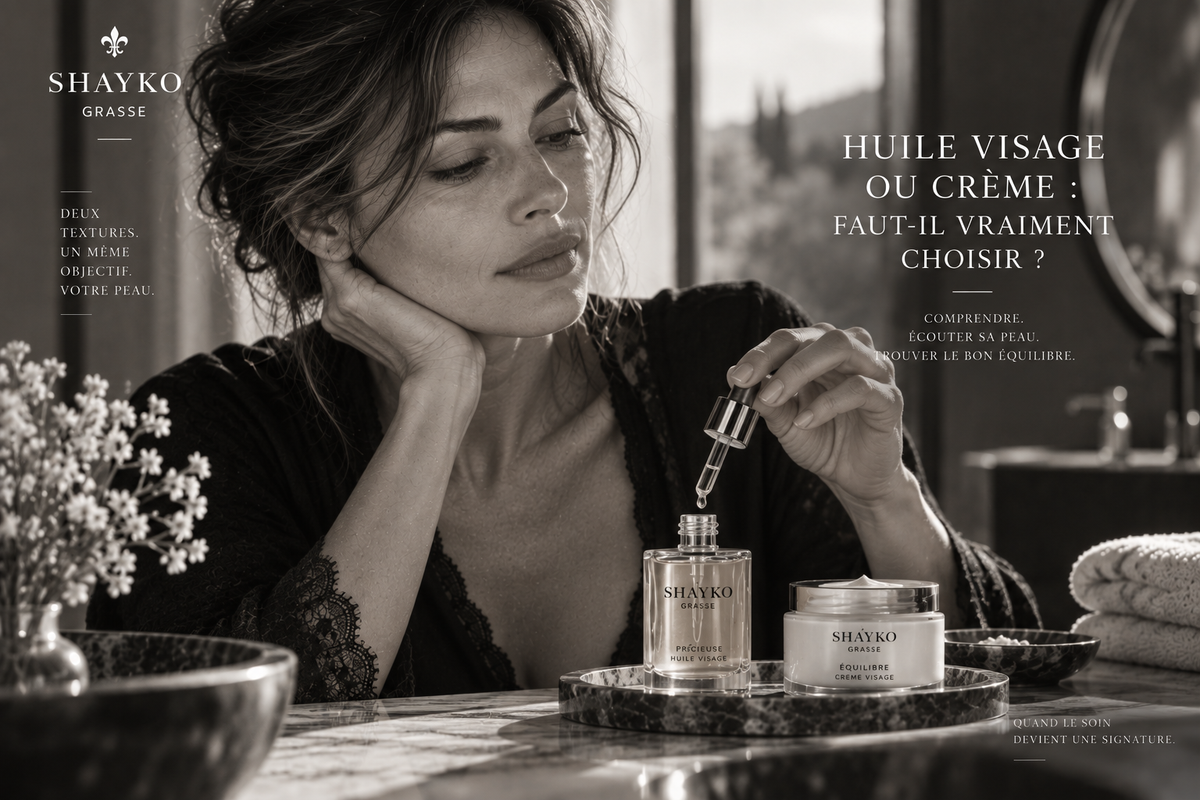
Sometimes, just a few drops are enough.
At other times, the skin seems to seek the enveloping feel of a cream.
Between the two, one question comes up regularly:
should you choose between a facial oil and a cream?
The answer begins with an essential distinction.
An oil and a cream are not simply two different textures intended to accomplish exactly the same thing.
Their architecture is different.
And this difference largely determines how they behave on the skin.
What is a facial oil?
A facial oil is generally a formula composed essentially of fats.
Depending on its formulation, it may combine various plant oils and other oil-soluble ingredients.
It therefore does not work like a classic cream containing an aqueous phase.
Its affinity with lipids gives it a distinctive sensory quality.
- It glides.
- It envelops.
- It can provide suppleness and comfort.
And it helps reinforce the feeling of protection sought in particular by some dry or uncomfortable skin.
But one distinction is important:
an oil does not directly provide water to the skin.
Does a facial oil hydrate the skin?
In everyday language, we often say that an oil “hydrates.”
From a cosmetic perspective, the reality requires greater precision.
Skin hydration mainly concerns the presence and retention of water in the superficial layers of the skin.
An oil is primarily lipid-based.
It can help limit water loss by forming a more or less occlusive film or by supplementing the lipid content of the routine.
It can thus indirectly help maintain hydration.
But it does not necessarily replace the functions of a formula containing an aqueous phase and humectants.
This is a fundamental distinction.
What is a cream?
A cream is generally an emulsion.
It combines an aqueous phase and an oil phase through a system that keeps them together.
This architecture gives the formulator a very different palette.
A cream may contain water, humectants such as glycerin, emollients, oils, butters, and various active ingredients depending on its formulation.
It can therefore act simultaneously on several aspects of skin comfort.
This is also why not all creams are alike.
Some are lightweight.
Some are more enveloping.
Between the two lies an entire language of textures.
So, which one hydrates better?
The question may not be phrased in the right way.
The question should instead be:
what does my skin need today?
- Skin may lack water.
- It may lack lipids.
- It may experience both situations simultaneously.
Dehydrated skin will in particular seek a formulation capable of promoting hydration and maintaining it.
Dry skin may benefit more from lipids and emollients.
And skin that is both dry and dehydrated may benefit from an approach combining these two dimensions.
That is why systematically setting oil and cream against each other oversimplifies reality.
Can oily skin use an oil?
Yes.
But that does not mean that every oil will suit every oily skin type.
Sebum production and hydration are two different phenomena.
Skin can produce a lot of sebum while being dehydrated.
It may also respond well to certain oily textures used in small amounts.
The choice then depends on the formula, the desired sensory experience, the rest of the routine and the skin's individual response.
So there is no rule that says:
oily skin = never any oil.
Since there is no rule that says:
dry skin = oil is mandatory.
Skincare becomes more interesting when you move beyond automatic habits.
Can an oil replace a cream?
For some people and at certain times, yes.
But not necessarily in every situation.
If a routine already provides sufficient hydration through other steps, a few drops of oil can sometimes provide the desired finishing touch.
Conversely, someone using only an oil when their skin is primarily lacking water may experience comfort without necessarily fully addressing this feeling of dehydration.
A cream may then be more suitable.
- Climate also plays a role.
- The season.
- Heating.
- Air conditioning.
- Age.
And simply how the skin is behaving that day.
Skincare is not a fixed equation.
Can a cream and an oil be used together?
Yes.
But once again, it is not obligatory.
The combination can be useful when the skin is seeking greater comfort or when you want to occasionally enrich a routine.
A simple approach generally consists of applying the most watery or lightweight textures before richer textures.
An oil can therefore be used after a cream, in a few drops, as the final step of the ritual.
But if the cream is sufficient, systematically adding an oil does not necessarily provide additional benefits.
Here we return to an essential principle of our approach:
adding is not always improving.
Can a few drops of oil be mixed with one's cream?
This can be pleasant from a sensory standpoint.
But mixing two products in the hand temporarily changes their texture and distribution.
It is therefore generally simpler to follow the intended use for each formula, then adjust the quantity or layer products when appropriate.
One or two drops may sometimes be enough.
A facial oil does not need to be used like a body oil.
The precision of the gesture also matters.
Why do some skin types prefer oil in the evening?
There is no biological necessity requiring oil to be used only at night.
It is often a matter of comfort and ritual.
Evening can sometimes allow more time.
The oily texture naturally accompanies facial massage.
The gesture slows down.
The skin is touched differently.
And skincare takes on a more sensory dimension.
This is one of the particularities of oil:
it easily transforms application into a ritual.
Is an oil necessarily more natural than a cream?
No.
A product's texture alone cannot determine its degree of naturalness, quality, or performance.
An oil can have a very simple composition.
A cream can be formulated with a significant proportion of ingredients of natural origin.
Conversely, the presence of a plant-based oil is not enough to define a product's overall quality.
The formulation must be considered as a whole.
Once again, the shortcut is appealing.
The formula is more relevant.
Is a rich texture necessarily more effective?
No.
Sensory richness is not a measure of efficacy.
A very enveloping texture can be perfectly suited to dry skin and become uncomfortable for another skin type.
Conversely, a lightweight texture can meet exactly the needs of skin seeking hydration and comfort without a rich film.
The luxury of a skincare product therefore does not lie in its thickness.
It lies in its precision.
At SHAYKO, oil and cream are used in two different steps
Our Face collection was specifically designed to allow for this modulation.
CONFORT offers a more fluid approach.
ÉQUILIBRE, GALBE and RESSOURCE explore different cream balances.
PLÉNITUDE responds to the search for a more enveloping texture.
And PRÉCIEUSE, our facial oil, introduces another relationship with skincare.
A few drops.
A slower gesture.
A texture that naturally accompanies massage and ritual.
We therefore do not consider PRÉCIEUSE to be “better” than a cream.
No more than a cream would be superior to an oil.
They simply speak two different languages.
Do you need to have both?
Not necessarily.
A skincare routine is not intended to reproduce an entire collection in a bathroom.
Some skin types will be perfectly satisfied with a cream.
Others will appreciate oil.
Some will alternate according to the seasons.
Others will use a few drops of oil only when their skin seems to be asking for greater comfort.
This freedom matters.
Because a collection should offer possibilities.
Not create obligations.
Observe before adding
The skin has a very simple way of informing us.
- It feels tight.
- It shines.
- It becomes uncomfortable.
- It seems to lack suppleness.
- Or, on the contrary, it feels perfectly balanced.
Before adding a new product, it may therefore be useful to ask yourself:
what am I really trying to improve?
This question prevents a great deal of accumulation.
And it allows us to rediscover something cosmetics sometimes forget:
observation.
Oil or cream: the answer is ultimately personal
There is no winner.
- An oil provides a distinctive lipid-based experience.
- A cream combines water and oils in a different structure.
- They can be used separately.
- Alternated.
- Or combined.
The decision depends less on a universal rule than on the skin, the climate, the moment, and the pleasure of use.
At SHAYKO, we therefore do not seek to pit textures against each other.
We prefer to give them a purpose.
Because when every gesture has a reason to exist, the routine becomes simpler.
More readable.
And probably more elegant.
Precision sometimes begins with knowing what you can do without.
“An oil and a cream are not opposites. They simply offer the skin two different ways of being cared for.”
SHAYKO Grasse
Quand le soin devient une signature.