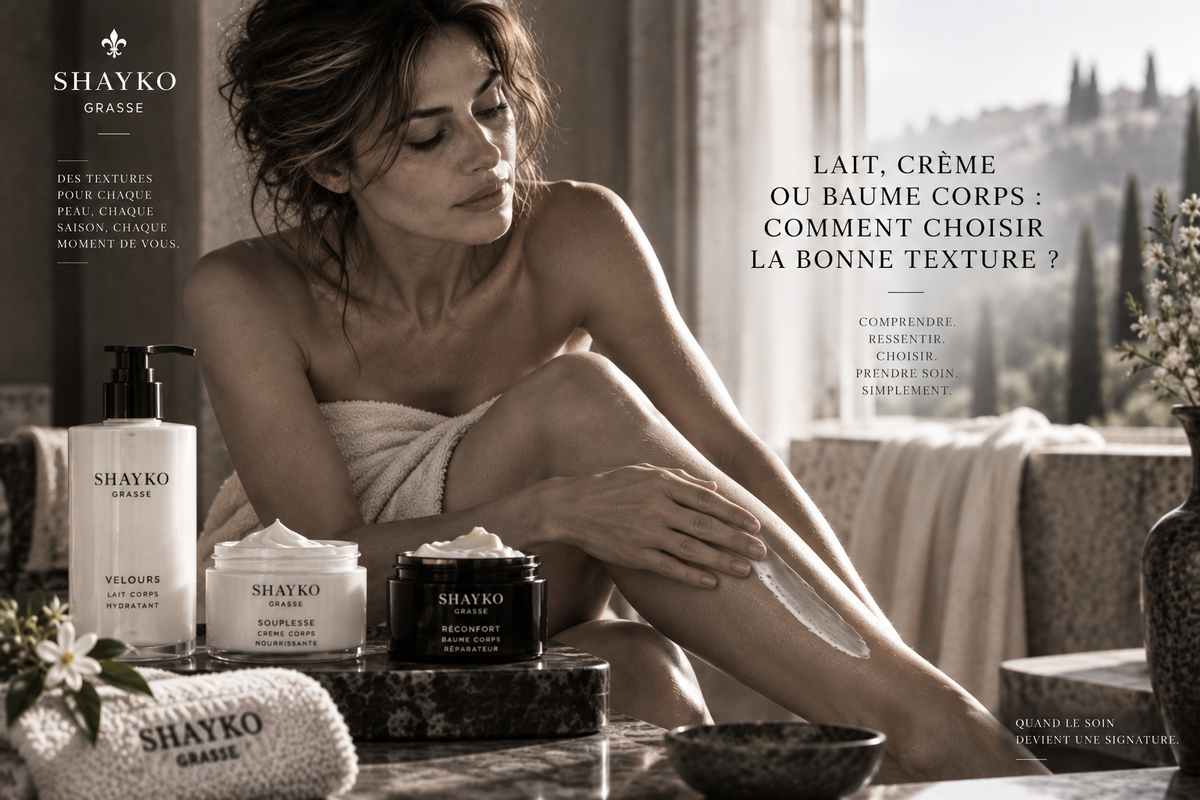
- Lotion.
- Cream.
- Balm.
Three words that seem to describe three levels of richness.
- The lotion would be light.
- The intermediate cream.
- The highly nourishing balm.
This representation is broadly useful.
But it only tells part of the story.
Because behind the texture of a body care product lies, above all, a formulation architecture.
- Water.
- Oils.
- Emollients.
- Humectants.
- Texture agents.
And many other components used to create a particular experience on the skin.
Choosing a texture is therefore not simply a matter of deciding whether you prefer a fluid or thick product.
It is important to understand what the skin is seeking and how we want it to feel after application.
What is body lotion?
A body lotion is generally a relatively fluid emulsion.
It therefore combines an aqueous phase and a lipid phase in a texture designed to spread easily.
This fluidity offers an obvious advantage.
The body represents a large surface area.
- Arms.
- Legs.
- Shoulders.
- Abdomen.
- Décolleté.
A product that glides easily allows the application to be carried out quickly and evenly.
Lotion is therefore particularly appealing when you want to provide comfort without feeling an overly noticeable texture.
Is body lotion less nourishing than cream?
Not necessarily.
A product's visible consistency is not enough to determine its composition or how it behaves on the skin.
A lotion can perfectly well contain plant oils, humectants, and various emollients.
A thicker cream may simply have a different texture architecture.
So an overly simple equation should be avoided:
thicker = more effective.
In cosmetics, sensoriality and performance are not synonymous.
Why choose a body cream?
A cream generally has more body than a lotion.
It can provide a more enveloping sensation and leave a more perceptible presence after application.
This characteristic can be particularly appreciated when the skin becomes dry.
In winter.
After certain environmental exposures.
Or simply when you like to feel the product more on your skin.
Cream can also be useful on targeted areas that require greater comfort.
But it is not automatically superior to lotion.
It simply offers a different relationship with touch.
And what about balm?
The balm generally belongs to an even more enveloping category.
Depending on its formulation, it may contain a significant proportion of fatty substances and have a dense texture.
It can be particularly pleasant on very dry or rough areas.
- Elbows.
- Knees.
- Shins.
- Heels, depending on the product concerned.
But using a balm all over the body when the skin does not need it can become uncomfortable.
A rich texture must serve a purpose.
Not the idea that more product necessarily means more care.
Why does the skin not need the same texture all year round?
Because its environment changes.
- In summer, heat and perspiration can make some rich textures less pleasant.
- A fluid lotion can then become particularly appealing.
- In winter, outdoor cold and heated indoor air can intensify dryness.
- A more enveloping texture may become preferable.
It is therefore perfectly normal to like one product in January and prefer another in July.
The skin is not fickle. It adapts.
The routine should be able to do the same.
Should you choose according to your skin type?
Yes, but not only.
Naturally dry skin will generally appreciate greater lipid comfort.
Normal skin may prefer a lightweight texture for daily use.
But the choice also depends on:
- the climate,
- the season,
- how often they shower,
- age,
- areas of the body,
- clothing,
- and simply the pleasure of using it.
Two people who both have dry skin may therefore prefer completely different textures.
Can several textures be used on different areas?
Absolutely.
It is even a particularly logical approach.
- The legs may be dry.
- The décolleté may feel perfectly comfortable.
- The elbows may be rougher.
- The arms may not need anything specific.
Why apply exactly the same amount and richness everywhere?
We are used to adjusting our facial care routine.
The same principle can be applied to the body.
A lotion over the entire body.
A richer texture only on certain areas.
A few targeted gestures.
Precision can also be geographical.
Does body care need to absorb immediately?
Not necessarily.
But its absorption time strongly influences the experience.
Some people want to get dressed immediately after application.
They will look for a texture that quickly disappears beneath the fingers.
Others enjoy a longer massage and an enveloping sensation.
Neither experience is superior.
A successful body care product is also one that suits the way we live.
This is an essential point.
Because if a texture is technically excellent but becomes a daily inconvenience, it may simply stop being used.
Can a lightweight texture suit dry skin?
Yes.
Particularly if its formulation provides what the skin needs for comfort.
The perceived texture depends on many parameters.
A lotion can feel light upon application while leaving the skin comfortable for several hours.
This is precisely one of the major challenges of modern formulation:
providing without weighing down.
Creating presence without leaving heaviness.
Why is the finish so important?
Because body care does not stop when we have finished applying it.
The skin then touches clothing.
- The sheets.
- The hands.
The finish therefore becomes an integral part of the experience.
Some seek skin that feels almost bare.
- Others a velvety touch.
- Some seek a satin-like sensation.
This sensory vocabulary is not incidental.
It describes the relationship that remains between the product and the skin after application.
What does a « velvety » touch mean?
It is not a scientific measurement.
- It is a sensation.
- Soft skin.
- An almost powdery touch.
- A comfortable surface where the presence of the care becomes discreet.
The word VELOURS precisely expresses this idea in our Body collection.
Not an abstract promise.
But a sensory destination.
And « SOUPLESSE »?
Flexibility belongs to another perception.
Dry skin can sometimes feel tighter, rougher and less comfortable when moving.
Body care can improve its feel and comfort by providing, depending on the formula, water, humectants, lipids and emollients.
SOUPLESSE conveys this search for skin that feels softer and more flexible to the touch.
Why talk about RÉCONFORT?
Because there are times when the skin is not simply asking for hydration.
- It calls for a sensation.
- After exposure to the cold.
- After a shower.
- When it feels tight.
- When the legs feel particularly dry.
The word RÉCONFORT describes this search for an enveloping sensation.
It is almost an emotional word.
And body care has this particular quality:
it constantly lies between physiology and sensation.
And SATIN?
- SATIN evokes the finish more than anything else.
- The light on the skin.
- The softness of the touch.
That impression of a smooth surface without heaviness.
Satin skin is not necessarily skin covered in oil.
On the contrary.
The term often evokes a subtle presence.
A product perceived more through its result than its weight.
Is the richest texture the most luxurious?
No.
This is an idea we particularly want to avoid at SHAYKO.
Luxury is not measured by thickness.
A nearly imperceptible texture can be extremely sophisticated.
Creating a fluid lotion that glides perfectly, provides comfort, then disappears elegantly can require as much work as a very rich formula.
Sophistication lies in balance.
Not in the amount of product left on the skin.
Should you apply your treatment to dry or slightly damp skin?
Both are possible.
After showering, applying an emulsion while the skin is still slightly damp can be particularly pleasant.
The texture spreads easily and naturally accompanies the end of the ritual.
But the skin does not need to be wet.
What matters most is finding a gesture simple enough for it to become natural.
Body care should not require complex planning.
How long should you massage?
There is no required duration.
The product simply needs to be spread evenly.
But massage adds an additional dimension.
The hands move across the skin.
The gesture slows.
The fragrance develops.
The texture evolves under the fingers.
This is where body care differs from facial care.
The surface is larger.
Movement does too.
And sensoriality takes up more space.
At SHAYKO, we do not want to create a hierarchy of textures
A lotion is not the entry-level version of a cream.
A cream is not an inferior version of a balm.
Each formulation responds to an experience.
Our Body collection — VELOURS, RÉGÉNÉRATION, SOUPLESSE, RÉCONFORT and SATIN — is precisely intended to let you explore these different sensations without turning the choice into a competition.
We do not want to ask:
what is the richest product?
We prefer to ask:
what feel are you looking for today?
This question changes everything.
The skin may choose differently tomorrow
Today, a lotion.
Tomorrow, more comfort.
In winter, a more enveloping texture.
In summer, something lighter.
After a long day, a slower massage.
In the morning, a treatment that lets you get dressed quickly.
A body routine can be much more intuitive than we imagine.
It does not need to be fixed.
The right texture is the one you forget
It may seem paradoxical.
We call it sensoriality.
- In fragrance.
- In glide.
- In feel.
And yet, a perfectly chosen texture often ends up disappearing.
- The skin feels comfortable.
- Clothes do not stick.
- The product no longer imposes its presence.
- Only a sensation remains.
Perhaps that is where true sophistication lies.
Not in a treatment that constantly seeks to draw attention to itself.
But in the one that completes its gesture, then fades away.
At SHAYKO, we like this idea.
The product should not dress the skin in its place. It should allow it to rediscover its own feel.
“The most precious texture is not the richest one. It is the one that provides exactly what the skin needs, then knows how to fade into the background.”
SHAYKO Grasse
Quand le soin devient une signature.