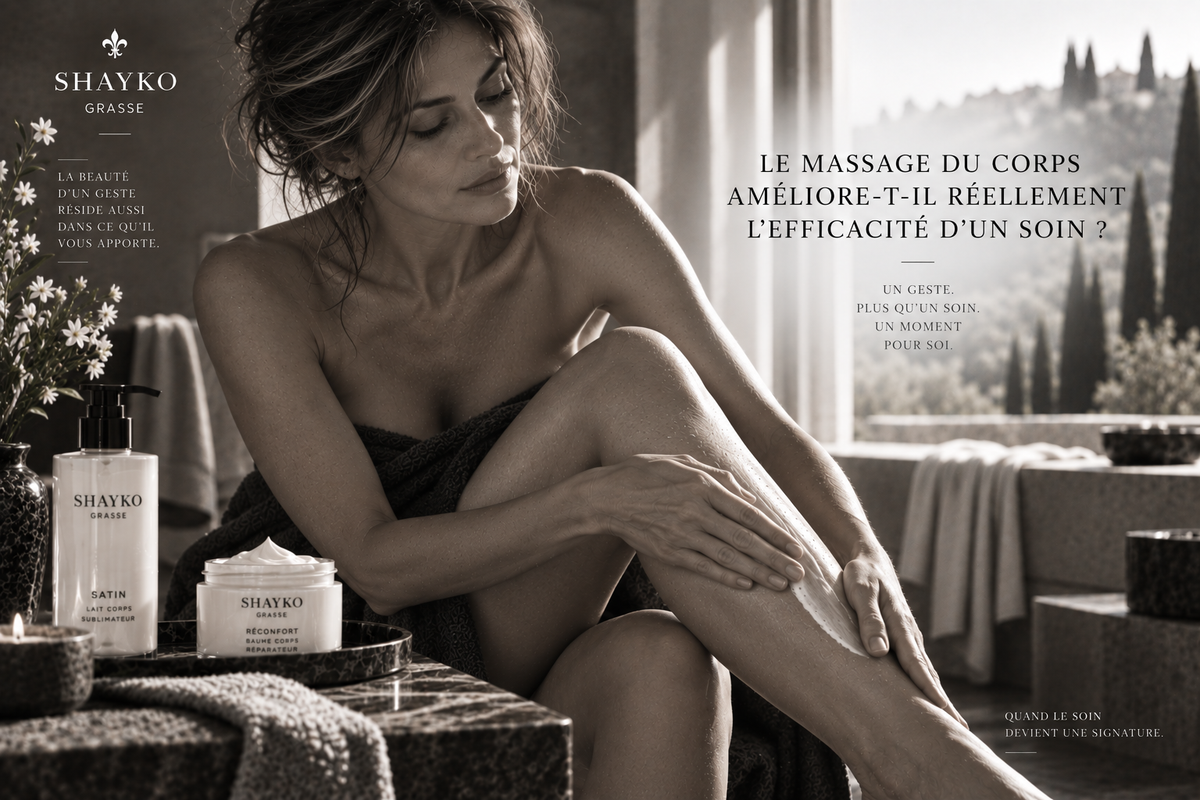
- A dab of lotion.
- A few movements.
- Then the hands slow down.
- They move upward along the legs.
- Move along the arms.
- The shoulders.
- The skin gradually changes beneath the fingers.
- The product disappears.
- And the gesture remains.
Massage naturally complements body care.
To such an extent that we sometimes attribute many powers to it.
- Help active ingredients penetrate.
- Firm.
- Promote drainage.
- Detoxify.
- Eliminate cellulite.
- Stimulate circulation.
But what can massage really contribute when applying a cosmetic product?
And above all:
where does its role end?
Why do we naturally massage a body care product?
For a very simple reason.
The product must be distributed.
Unlike the face, the body represents a large surface area.
An emulsion applied to the leg needs to be spread to form a relatively even layer.
Massage therefore first allows the formula to be distributed.
- It supports its glide.
- Its spread.
- Then its evolution through to the finish.
- That is its primary function.
- And it is already essential.
Does massaging help a cream penetrate better?
The term “penetrate” should be used with caution.
When we massage a cream, we often have the impression that it has fully entered the skin because it gradually becomes less visible.
In reality, several phenomena occur.
- The product spreads.
- Some of its aqueous phase may evaporate.
Depending on their characteristics, some components remain in the superficial layers or on the surface of the skin.
- The texture changes.
- The residual film becomes less perceptible.
Saying that massage “pushes active ingredients deep into the skin” would therefore be far too simplistic.
The penetration of an ingredient depends above all on its chemical nature, the formulation, and the skin barrier.
Fingers do not force a molecule through the skin.
So why take the time to massage?
Because massage improves the quality of the application.
Applying it too quickly may leave some areas insufficiently covered and others with too much product.
A few movements allow for a more uniform distribution.
- The product is distributed more evenly.
- The touch becomes more even.
- And above all, the time spent allows you to feel the texture evolve.
- Massage does not necessarily transform the formula.
- It allows you to use it more effectively.
Should you massage for a long time?
No.
There is no universal duration.
For a fluid lotion, a few movements may be perfectly sufficient.
A richer texture may naturally invite a longer massage.
The goal is not to continue until the skin is red or heated.
The pressure should remain comfortable.
Body care is not a mechanical test.
Should you massage until the product has disappeared completely?
Not necessarily.
Some formulas intentionally leave a light film.
Others have an almost imperceptible finish.
The formulation should be allowed to express the sensorial quality for which it was designed.
Trying to eliminate every sensation completely by rubbing more can simply lead to skin irritation.
A good application ends when the product has been properly distributed and the touch becomes pleasant.
Which direction should the legs be massaged in?
Upward movements from the ankles toward the thighs are often recommended.
This movement is pleasant and easy to incorporate into a ritual.
But when applying a simple cosmetic product, this orientation should not be turned into a medical rule.
The product does not become ineffective if the hand changes direction.
What matters above all is gentle, even application.
Therapeutic massage or drainage techniques serve other purposes and fall within a specific practice.
Can massage temporarily improve local circulation?
The mechanical manipulation of the tissues can cause temporary local changes, particularly in superficial circulation.
This is also why the skin can sometimes become slightly pinker during a massage.
But it would be excessive to conclude from this that a quick cosmetic massage “gets the entire circulation going again.”
Even less so that it treats a circulatory disorder.
A local, temporary sensation must be distinguished from a therapeutic action.
Can massage promote drainage?
The word drainage is used particularly often in the body-care sector.
- But manual lymphatic drainage is a specific technique, with particular movements and indications.
- Applying cream to the legs for a few minutes should not automatically be presented as lymphatic drainage.
- Cosmetic massage can provide a pleasant sensation of lightness.
- It can support well-being.
But that is not enough to attribute a medical function to it.
And “detoxify”?
Our body already has organs responsible for eliminating and metabolizing many substances, particularly the liver and kidneys.
- A cream and a body massage do not remove “toxins” accumulated beneath the skin as if emptying a tank.
- The term “detox” has considerable marketing power.
- But its cosmetic reality is often much less precise.
At SHAYKO, we prefer not to need this kind of promise.
A treatment can be remarkable without claiming to purify the entire body.
Can cellulite be made to disappear through massage?
No.
Cellulite reflects a complex architecture involving, among other things, subcutaneous adipose tissue, fibrous structures and the characteristics of the skin.
- It is extremely common and entirely physiological.
- Massage can temporarily alter the appearance of the skin's surface, particularly through its mechanical effects and effects on local fluids.
- A moisturizing treatment can also make the skin appear more supple and smoother.
- But that does not mean that a few minutes of massage destroy cellulite.
- Here again, a distinction must be made:
temporary improvement in appearance
and
deep structural transformation.
Can massage firm the skin?
Not in the sense that it would rebuild the body's deeper structures.
- Firmness depends on many factors:
- skin,
- collagen,
- elastin,
- subcutaneous tissue,
- muscles,
- age,
- weight fluctuations,
- genetics.
- Massage cannot replace all of these structures.
- It can, however, immediately improve how the skin is perceived.
- Hydrated, massaged, comfortable skin may feel more supple and appear smoother.
- This result has value.
It is simply not necessary to turn it into an impossible promise.
Why does massage sometimes give the impression that the treatment works immediately?
Because several sensations occur simultaneously.
- The skin is touched.
- The formula provides comfort.
- Massage creates warmth.
- The fragrance develops.
- The finish becomes softer.
- The surface can sometimes appear more luminous.
- Our perception of the result is therefore holistic.
- We do not feel only the formula.
We feel the entire experience.
That is precisely what makes body care so distinctive.
Are the hands part of the product?
In a way, yes.
Not chemically.
But in the experience, absolutely.
A body lotion does not exist only in its bottle.
It exists when it is applied.
- Spread.
- Massaged.
- Then forgotten.
The gesture is therefore part of how the formula is experienced.
That is why a good texture must be designed with its application in mind.
Why do some textures invite massage more than others?
Because they have different working times.
- A very fluid formula can spread quickly.
- A richer emulsion can retain more slip.
- An oil offers yet another experience.
The formulator can therefore create a texture that almost disappears immediately or, on the contrary, accompanies several movements.
This choice directly influences the ritual.
Sensory appeal is not an accidental consequence.
It can be considered from the design stage.
Do you need to use a lot of product to massage for longer?
No.
An excessive amount may simply remain on the surface.
The right amount depends on the formula and the area.
For a body lotion, it is generally preferable to start with a reasonable amount and add more if necessary.
Massage should not become a way to overconsume the product.
A few well-executed movements may be enough.
Why is massage also a form of observation?
Because we look at our faces a great deal.
But we touch our bodies more.
When applying a treatment, we may notice:
a drier area,
roughness,
a change in texture,
a slight irritation,
or simply an area that requires greater comfort.
This attention has particular value.
The massage then becomes a way to reconnect with the perception of your own skin.
Does the massage always need to be vigorous?
No.
- It is often unnecessary.
- The pressure can remain gentle.
- Especially when the skin is dry, sensitive, or weakened.
- A body treatment does not require working the tissues forcefully.
- Gentleness is often enough to distribute an emulsion perfectly.
- The precision of the movement is more important than its intensity.
Can you massage immediately after showering?
Yes.
It is even a particularly natural time.
After gently patting the skin dry, optionally leaving it very slightly damp, the treatment can be applied.
- The warmth of the bathroom.
- Clean skin.
- Time slowing down.
- Everything encourages the ritual.
There is no need to wait for a particular moment.
Why does the evening seem ideal?
Not because the cream becomes more effective at 10 p.m.
But because we are often more available.
In the morning, we want to get dressed.
Leave.
Start the day.
In the evening, a few extra minutes become possible.
The massage can then take on a different function.
It is no longer intended solely to distribute the product.
It becomes a passage between the day and rest.
Does the fragrance change during the massage?
Yes, our perception can evolve during application.
The warmth of the skin, the evaporation of the most volatile components, and time gradually alter what we perceive.
- The fragrance opens.
- Then it draws closer to the skin.
In a body treatment, this evolution accompanies movement.
And for a Maison connected to Grasse, this dimension naturally holds particular importance.
At SHAYKO, the gesture must never serve to invent a promise
We could say:
- massage to firm.
- Massage to drain.
- Massage to detoxify.
- Massage to reshape.
- These expressions are appealing.
But they do not correspond to our way of conceiving Haute Cosmétique de Précision.
We prefer to say exactly what the gesture brings.
- It distributes the formula.
- It complements its sensoriality.
- It gives us time.
- It transforms application into a ritual.
- It reconnects us with the feel of our skin.
- And that is already a great deal.
VELOURS, SOUPLESSE, RÉCONFORT, SATIN, RÉGÉNÉRATION: five experiences of the gesture
In our Body collection, each territory can naturally lead to a different perception.
VELOURS calls to mind softness.
SOUPLESSE evokes movement.
RÉCONFORT invites a feeling of being enveloped.
SATIN speaks of the finish.
RÉGÉNÉRATION evokes the time we give ourselves.
But none of these sensations requires a complicated technique.
- The hands are enough.
- The product.
- A few minutes.
Does massage transform a treatment?
Yes.
- But perhaps not in the way we imagine.
- It does not turn an emulsion into an intensive treatment.
- It does not give an ingredient a power it does not possess.
- It primarily transforms our relationship with the product.
- A functional application becomes a moment.
- A texture becomes a material.
- A fragrance becomes a presence.
And the skin, which we often forget during the day, once again becomes something we feel.
When the gesture becomes as important as the product
Cosmetics talk a great deal about formulas.
- And it is right.
- Formulation is essential.
- But a perfect formula that was unpleasant to use would lose part of its meaning.
The treatment exists at the meeting point of two things:
what the product can do
and
the way we use it.
At SHAYKO Grasse, we do not want to choose between science and sensoriality.
- Science gives the treatment its precision.
- The gesture gives it its human dimension.
- And between the two lies the skin.
Perhaps that is exactly where the ritual begins.
“Massage does not give a treatment powers it does not possess. It gives it something different: time to fully meet the skin.”
SHAYKO Grasse
Quand le soin devient une signature.