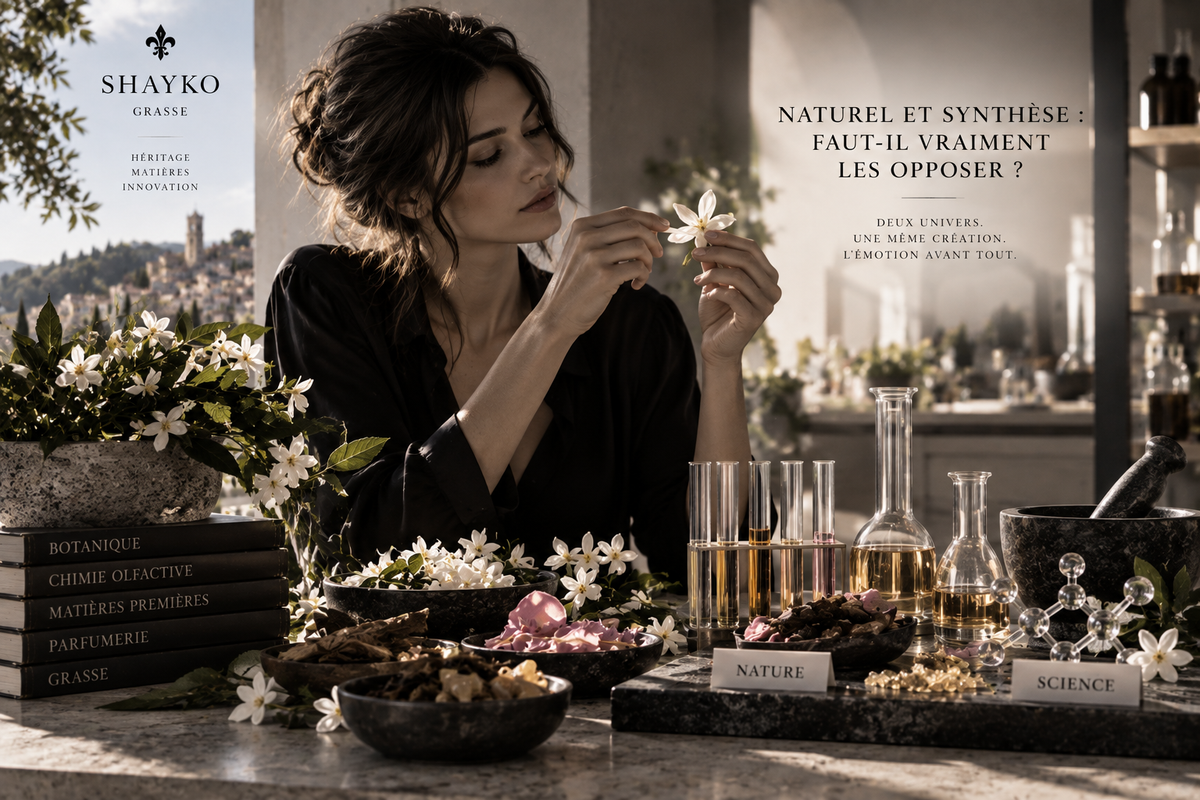
A widespread idea: natural is necessarily better
In the world of cosmetics and fragrance, the word natural has a particular power.
- It evokes flowers.
- Plants.
- Harvests.
- Landscapes.
- The earth.
It immediately evokes something we understand.
Conversely, the word synthetic can sometimes seem colder, more technical or less desirable.
Yet this opposition is misleading.
A material’s origin is not enough to determine its quality, olfactory interest or safety profile.
In perfumery, natural and synthetic materials are not necessarily adversaries.
They belong to the same palette.
What is meant by a natural material in perfumery?
Natural fragrant materials can come from different parts of the plant.
- Flowers.
- Barks.
- Leaves.
- Woods.
- Roots.
- Seeds.
- Resins.
- Citrus fruits.
Depending on the material, different techniques can be used to obtain fragrant extracts, including distillation, expression or extraction.
This produces different forms of raw materials used by the perfumer.
But a natural material is not necessarily a single molecule.
It can be a naturally complex blend of numerous molecules.
It is precisely this complexity that often contributes to its olfactory richness.
A rose is not simply “a rose scent”
When we breathe in a rose, we perceive an overall impression.
Yet its scent results from a complex blend of odoriferous compounds.
The perfumer can use a material derived from the rose.
But they can also work with certain molecules present in its olfactory universe, combine them with other materials and construct an entirely new interpretation.
A rose can thus become:
- fresh,
- green,
- powdery,
- velvety,
- dark,
- luminous,
- or almost abstract.
Perfumery begins precisely when the material ceases to be merely reproduced and becomes interpreted.
What does “synthetic” mean in perfumery?
A synthetic material is obtained through controlled chemical processes rather than being directly extracted as such from a flower or plant.
But the term encompasses very different realities.
Some molecules used in perfumery may be identical to molecules also found in nature.
Others made it possible to create new olfactory sensations and considerably expand the perfumer’s vocabulary.
Synthesis therefore does not necessarily mean “imitation.”
It can also be creation.
Chemistry transformed the history of fragrance
The emergence and development of synthetic molecules profoundly changed modern perfumery.
The perfumer was no longer limited to the materials that could be extracted from nature.
- Its palette expanded.
- New facets emerged.
- New accords could be imagined.
Some natural materials could also be complemented, extended, or interpreted differently.
Perfumery thus became an art in which nature and science can engage in dialogue.
Do the great creations of perfumery use only natural materials?
Very often, no.
A large part of modern perfumery was built through the combination of natural materials and materials derived from synthesis.
This dialogue allows the perfumer to play with:
diffusion,
transparency,
depth,
olfactory texture,
longevity,
and naturally, the identity of the composition.
It would therefore be reductive to consider that a sophisticated fragrance should necessarily be composed exclusively of natural materials.
Sophistication lies in the composition, not in an ideological opposition between materials.
Does natural automatically mean allergen-free?
No.
This is a particularly important point.
A natural substance may contain compounds that can be allergenic for some people.
The plant-based origin of a material is therefore no guarantee that it has no allergenic potential.
This is precisely why cosmetic regulations focus on the substances present and their use, not solely on their origin.
A material does not automatically become preferable simply because it comes from a flower.
And does synthetic automatically mean dangerous?
Nor.
The reverse reasoning would be equally incorrect.
A synthetic material must be assessed according to its own characteristics, the conditions under which it is used, and the applicable regulatory framework.
Certain molecules may be used under defined conditions.
Others are restricted or prohibited.
So the relevant question is not simply:
“Is it natural or synthetic?”
But rather:
“What is this material, why is it used, and under what conditions?”
At SHAYKO, we prefer to speak of selection
This distinction is important to our approach.
At SHAYKO Grasse, our aim is not to construct a narrative that systematically pits nature against science.
We prefer to ask ourselves which materials can create the desired olfactory experience while meeting the specifications defined for our fragrance compositions.
For the compositions concerned, we specifically seek fragrances without CMR substances and without declarable fragrance allergens, in accordance with the specifications established with our partners.
This choice leads us to consider a material for what it truly is.
Not simply because of the image associated with its origin.
Can a flower naturally contain a fragrance allergen?
Yes.
And this reality helps explain why the question is more complex than it appears.
Certain substances naturally present in essential oils or other plant extracts may be among the fragrance allergens regulated by European cosmetics legislation.
A composition meeting particularly restrictive specifications may therefore require limiting or excluding certain highly prestigious natural materials.
This is only an apparent paradox.
Respecting nature does not mean giving up the knowledge we have acquired about it.
A constraint can lead to reinventing an accord
Let us imagine that a perfumer wishes to create a particular floral impression.
A traditional solution might call for certain materials that do not meet the selected specifications.
- Another approach is therefore needed.
- Break down the desired impression.
- Identify what gives it its personality.
- Then reconstruct the accord from a different palette.
- This is where knowledge of materials becomes essential.
- A constraint does not necessarily eliminate creativity.
It may require them to become more precisely.
Can a flower then be recreated without using the flower directly?
Yes.
This is one of the great possibilities offered by composition.
The perfumer can construct an accord that evokes a flower from different materials.
The aim is not always to create a perfect copy of it.
They may seek to preserve its spirit.
- Freshness.
- Sensuality.
- Transparency.
- Depth.
A real flower then becomes an inspiration rather than an obligation.
Does this take anything away from the poetry of fragrance?
We think exactly the opposite.
Knowing the science behind a material does not destroy the emotion it evokes.
Knowing how a rose develops its fragrance does not prevent us from being moved when we breathe it in.
Understanding a molecule’s volatility takes nothing away from the elegance of a composition.
Knowledge does not replace emotion.
It simply allows for greater control in creation.
Grasse is not only a story of flowers
The fields are deeply rooted in Grasse’s imagination.
And rightly so.
But the history of Grasse perfumery is also a history of transformation.
- Extraction.
- Distillation.
- Research.
- Composition.
- Innovation.
- Transmission.
Laboratories and workshops evolved alongside the crops.
Reducing Grasse to a romantic image of flower fields would therefore mean forgetting part of what made it powerful.
Heritage and innovation have never ceased to meet.
Tradition does not prohibit modernity
A Maison can honor a heritage without seeking to reproduce the past exactly.
- Tradition can pass on a standard of excellence.
- A knowledge of materials.
- A culture of craftsmanship.
- A relationship with time.
- Contemporary science provides other tools.
- A better understanding of substances.
- Analytical methods.
- New possibilities for composition.
- More precise regulatory requirements.
- One does not erase the other.
- They can progress together.
Why is this question essential for SHAYKO?
Because it directly affects the way we conceive of Haute Cosmétique de Précision.
We do not wish to choose a material solely because it has an appealing history.
Nor reject it solely because its name sounds technical.
- We want to understand.
- Select.
- Compose.
- And preserving emotion when the formula is complete.
This approach sometimes requires abandoning overly simple oppositions.
- Nature versus science.
- Tradition versus innovation.
- Sensoriality versus precision.
On the contrary, we believe that the real work begins when these dimensions can coexist intelligently.
Tomorrow’s fragrance may not choose between the two
It will probably continue to draw from nature.
Because some materials possess extraordinary richness and history.
But it will also continue to benefit from research and chemistry.
Because they make it possible to explore, master and sometimes preserve in other ways.
The question may therefore no longer be whether a creation is natural or synthetic.
- But if it is right.
- Right in its intention.
- Right in its formulation.
- Right in its use.
And sufficiently mastered for all this complexity to ultimately disappear behind a single thing:
the emotion we feel when we breathe it in.
“Nature offers the perfumer a memory. Science opens new paths for them. Art begins when they know how to make them interact.”
SHAYKO Grasse
Quand le soin devient une signature.