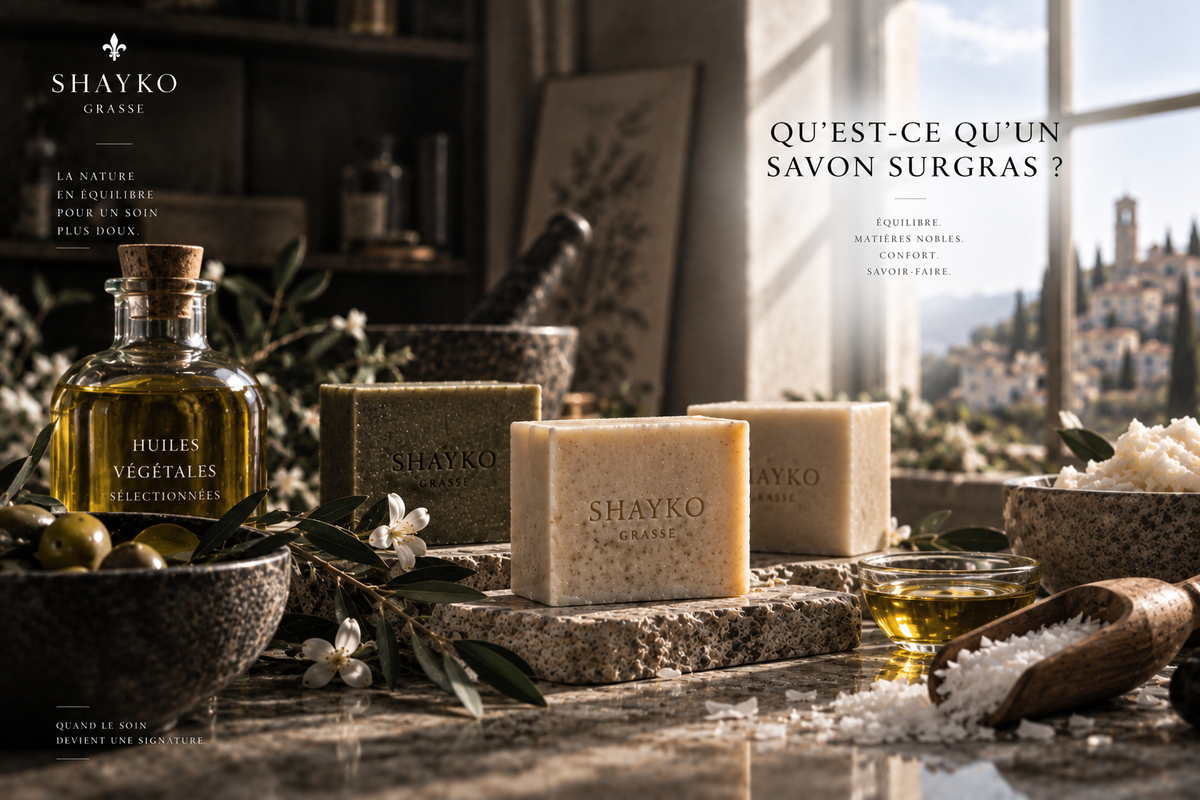
Behind a familiar word, a formulation reality
“Superfatting soap”.
The expression frequently appears on packaging and in advice for dry skin or skin seeking greater comfort.
The term almost seems to speak for itself.
A soap to which more oil has simply been added.
The reality is more nuanced.
To understand what a superfatting soap is, we need to return to what we discussed earlier: saponification.
Fats react with an alkaline base to form, among other things, soap and glycerine.
Superfatting occurs when the balance of this transformation is deliberately designed so that a fatty fraction remains unsaponified, or when certain fats are added according to the manufacturing process.
It is therefore above all a formulation choice.
It all starts with a balance
To make soap, the amount of alkaline base required depends on the fats used and their proportions.
The formulation can be calculated so as not to transform all the available fats.
A fraction therefore remains unsaponified.
This is commonly called superfatting.
There may also be other manufacturing approaches that allow additional fats to be introduced.
In any case, the general idea remains comparable:
not to focus solely on the cleansing function, but also to work on the sensation left by the soap during use.
Why leave a fraction of fat?
Cleansing is necessary.
But cleansing also means interacting with the fatty substances present on the skin's surface.
A cleanser that removes too much lipids can leave some skin feeling dry or tight.
The presence of unsaponified fats can help modulate the soap experience and provide a more comfortable sensation.
This is notably why the term “superfatting” is often associated with gentleness.
But an essential nuance should be added immediately:
Superfatting does not automatically mean gentle for all skin types.
Is the superfatting percentage enough to assess a soap?
No.
A number can be useful.
But it never tells the whole story of the formula.
Two soaps with a comparable level of superfatting can be very different depending on the fats used, the overall formulation, the manufacturing process and the other ingredients present.
Focusing solely on the percentage would amount to judging an entire recipe based on a single ingredient.
The figure provides information.
The formula provides the context.
Does more superfatting necessarily mean a better soap?
Here again, no.
Cosmetics regularly confronts us with the idea that “more” would necessarily be “better”.
More active ingredients.
Higher concentration.
More oil.
More superfatting.
Yet every formulation is based on balance.
A higher proportion of unsaponified fats can influence the soap’s hardness, integrity, lather, preservation and overall feel.
The aim is therefore not necessarily to seek the highest figure.
The key is to find the level that is consistent with the formula we wish to create.
Not all fats contribute the same things
Describing superfatting as a uniform quantity would also be reductive.
Oils and fats have different compositions.
Their behavior varies within the formulation.
The choice of ingredients therefore matters just as much as their quantity.
An oil is not selected solely because its name sounds appealing.
It must find its place within the soap’s overall balance.
Here, we return to a principle that runs through our entire vision of cosmetics:
the value of an ingredient also depends on how appropriately it is used.
Superfatting and glycerin: two different concepts
The two terms are sometimes associated, or even confused.
Yet they do not refer to the same thing.
Glycerin is produced, among other things, during the saponification reaction.
Superfatting corresponds to a fraction of fats that remains unsaponified, or to a strategy of enriching the formula with fats, depending on the process used.
A soap can therefore naturally contain glycerin and also be superfatted.
The two elements can both contribute to the overall product experience, but they should not be confused.
Does an extra-rich soap hydrate the skin?
The word “moisturizing” must be used precisely when discussing a rinse-off product.
A soap remains primarily intended for cleansing.
It remains on the skin for relatively little time before being rinsed off.
The value of extra oils is therefore better understood in terms of how cleansing is adjusted and the comfort experienced than as equivalent to a moisturizing treatment left on the skin.
After cleansing, some skin may still need suitable care.
This distinction is important.
A cleansing product and a leave-on treatment do not serve the same function.
Does dry skin necessarily need to use an extra-rich soap?
Not necessarily.
The skin’s reaction depends on many factors.
The product used.
The frequency of washing.
The water temperature.
The length of the shower.
The areas being cleansed.
The season.
And naturally, characteristics specific to the skin.
An extra-rich soap can be an interesting option when seeking greater comfort.
But no words printed on packaging should replace observing your own skin.
The gesture remains essential
Even a carefully formulated soap can become uncomfortable if the cleansing action is excessive.
Very hot water.
Long showers.
Intense rubbing.
Repeated use on areas that do not necessarily need it.
All of this influences the final sensation.
The quality of the soap matters.
The way it is used also matters.
It is a simple but essential idea: care can never be completely separated from the gesture that accompanies it.
What about lather?
An extra-rich soap can perfectly well produce pleasant lather.
But the level of extra oils and the selection of ingredients can help alter certain characteristics of this lather.
Once again, the aim is not necessarily to produce the most spectacular amount.
Fine, creamy, or more airy lather corresponds to different experiences.
Lather is part of the pleasure of using soap.
It should not become the sole measure of its quality.
An extra-rich soap does not turn into a cream
This is probably one of the most important distinctions.
Even when enriched with oils, a soap remains a rinse-off cleansing product.
It does not become the equivalent of a body oil, milk, or cream.
These products serve different functions.
Trying to turn every step of a routine into a complete treatment can sometimes blur their roles.
We prefer a simpler approach.
Cleanse thoroughly when necessary.
Then provide care when the skin requires it.
Each gesture can then remain precise.
Why, then, is this term nevertheless important?
Because it tells us something about how the soap was conceived.
It indicates that the formulator was not solely concerned with the product’s cleansing capacity.
It has also addressed the balance of the material and the desired sensation during or after washing.
The term therefore has genuine technical meaning.
It becomes problematic only when it is attributed powers that it cannot embody on its own.
Soap as an exercise in balance
Superfatted soap ultimately illustrates something much broader than its own category.
Creating does not always mean maximizing one property.
Sometimes, one characteristic must be allowed to be slightly less dominant for the whole to become more harmonious.
Cleansing power.
Lather.
Hardness.
Comfort.
Sensory experience.
Soap durability.
These elements must coexist.
And it is precisely this search for balance that transforms a simple cleansing material into a true formulation object.
Understanding rather than relying on a single word
“Superfatting” is therefore useful information.
But it deserves to be understood rather than simply sought after.
A good soap cannot be summed up by this one word.
It is the result of selected raw materials, controlled proportions, properly conducted saponification, and a clearly defined intention.
Superfatting then becomes what it should always be:
not an absolute promise, but one of the choices that shape the soap’s balance.
And when we begin to understand these choices, the soap gradually reveals all the sophistication concealed behind its simplest form.
“Superfatting is not a race to achieve a higher percentage. It is a search for balance between the function of cleansing and respect for the skin’s comfort.”
SHAYKO Grasse
Quand le soin devient une signature.