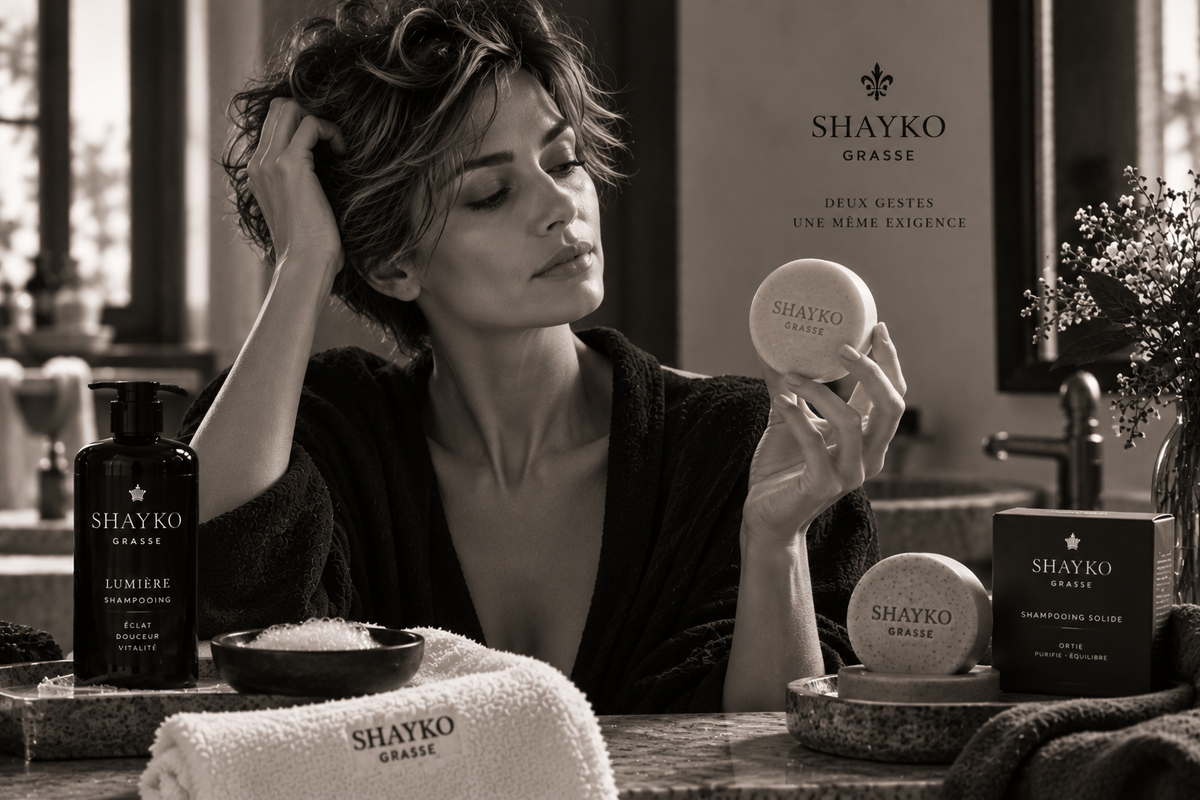
For decades, liquid shampoo became an obvious choice in our bathrooms.
Then solid shampoo returned to the forefront.
More compact.
Different in how it is used.
Often associated with a more minimalist approach to care.
This evolution has sometimes created an opposition between the two formats.
The solid would necessarily be more natural.
The liquid would necessarily be more sophisticated.
One would be better for the hair.
The other is more practical.
The reality is much more interesting.
A shampoo’s quality does not depend solely on its form. It depends above all on its formulation.
One objective: cleanse the scalp
Whether solid or liquid, a shampoo’s primary role remains the same.
Cleanse.
Over the course of days, the scalp accumulates sebum, perspiration, dead skin cells, dust and sometimes styling product residue.
Shampoo helps remove some of these elements through cleansing agents called surfactants.
They notably make it possible to disperse oils in water so that they can be removed during rinsing.
The general principle is therefore comparable.
What changes is the way the formula is constructed.
Why is a liquid shampoo… liquid?
It seems obvious.
But this difference is fundamental.
A liquid shampoo generally contains a significant proportion of water.
This water forms the medium in which the formula’s various components are dispersed.
- Cleansing agents.
- Conditioning agents.
- Plant extracts.
- Fragrances.
- And other ingredients needed to maintain the product’s balance.
This structure creates a fluid texture that can be distributed immediately over the scalp.
- The motion is familiar.
- Pour a small amount into your hand.
- Distribute.
- Massage.
- Then rinse.
Solid shampoo works differently
In a solid shampoo, the amount of water present in the formula is generally much lower.
The ingredients are concentrated in a solid mass that is gradually released upon contact with water.
The product must therefore first be moistened.
It can then be worked between the hands or applied sparingly to wet hair, depending on its formulation.
This difference transforms the way you use it.
You no longer measure the product by pouring an amount into your palm.
You learn to take out the product gradually.
And it can sometimes take a few uses to find the right technique.
Is solid shampoo necessarily more natural?
No.
- The format alone cannot determine how natural a formula is.
- Solid shampoo can contain different types of cleansing agents.
- Liquid shampoo as well.
- The composition should therefore be considered rather than the product's appearance.
Solid does not automatically mean natural.
Likewise, liquid does not necessarily mean artificial or harsh.
The formulation remains decisive.
This distinction is important because it helps move beyond preconceived ideas.
And what about the hair?
Here again, there is no universal answer.
Some hair types particularly appreciate the experience of using solid shampoo.
Others prefer the fluidity and ease of distribution of a liquid formula.
The choice depends in particular on the scalp.
- The nature of the hair.
- How often the hair is washed.
- The desired result.
- And simply part of the pleasure of use.
- Because the sensory experience is also part of care.
A product you enjoy using naturally fits more easily into a regular routine.
The way you use solid shampoo is essential
One of the most common mistakes is rubbing solid shampoo vigorously along the entire length of the hair.
This is generally not necessary.
As with liquid shampoo, the main objective is to cleanse the scalp.
The product can be moistened and then gently worked to create enough lather to massage the roots.
The lengths do not need to be rubbed excessively.
When rinsing, the product naturally glides along the hair fiber.
This approach makes it possible to use solid shampoo with greater precision.
Solid shampoo has another advantage: its concentration
The absence of a large quantity of water generally makes the product more compact.
A small bar can therefore represent many uses.
But its lifespan depends greatly on how it is stored.
After each use, a solid shampoo must be able to dry properly.
If it remains constantly in water or on a damp surface, it will soften and be used up much more quickly.
A soap dish that allows water to drain therefore becomes almost as important as the shampoo itself.
Do you have to choose between solid and liquid?
Not necessarily.
This may be the most important idea.
These two formats can perfectly coexist within the same approach to care.
Liquid shampoo offers an extremely intuitive gesture and makes it possible to create particularly precise textures.
Solid shampoo offers another experience.
- More compact.
- More tactile.
- With a different relationship to the material.
- The choice should therefore not be ideological.
- It should be personal.
At SHAYKO, we have chosen to work with both.
This complementarity corresponds precisely to our vision of haircare.
On one side, our liquid shampoos MAÎTRISE, MATIÈRE and LUMIÈRE meet different hair needs.
On the other, our solid shampoos NILA, SHIKAKAI and SOUFFLE explore another way of approaching the haircare ritual.
- Two gestures.
- Two formulation architectures.
- Two experiences.
But the same requirement: understand the material before creating the treatment.
We therefore do not regard solid shampoo as a replacement for liquid shampoo.
Nor the reverse.
We regard them as two possible expressions of the same essential gesture.
Taking care of your scalp and hair with precision.
Because in cosmetics, the best format is not the one that follows the trend.
It is the one that truly meets your needs.
“Solid or liquid, the form changes. The requirement remains: cleanse precisely and respect the nature of the hair.”
SHAYKO Grasse
Quand le soin devient une signature.