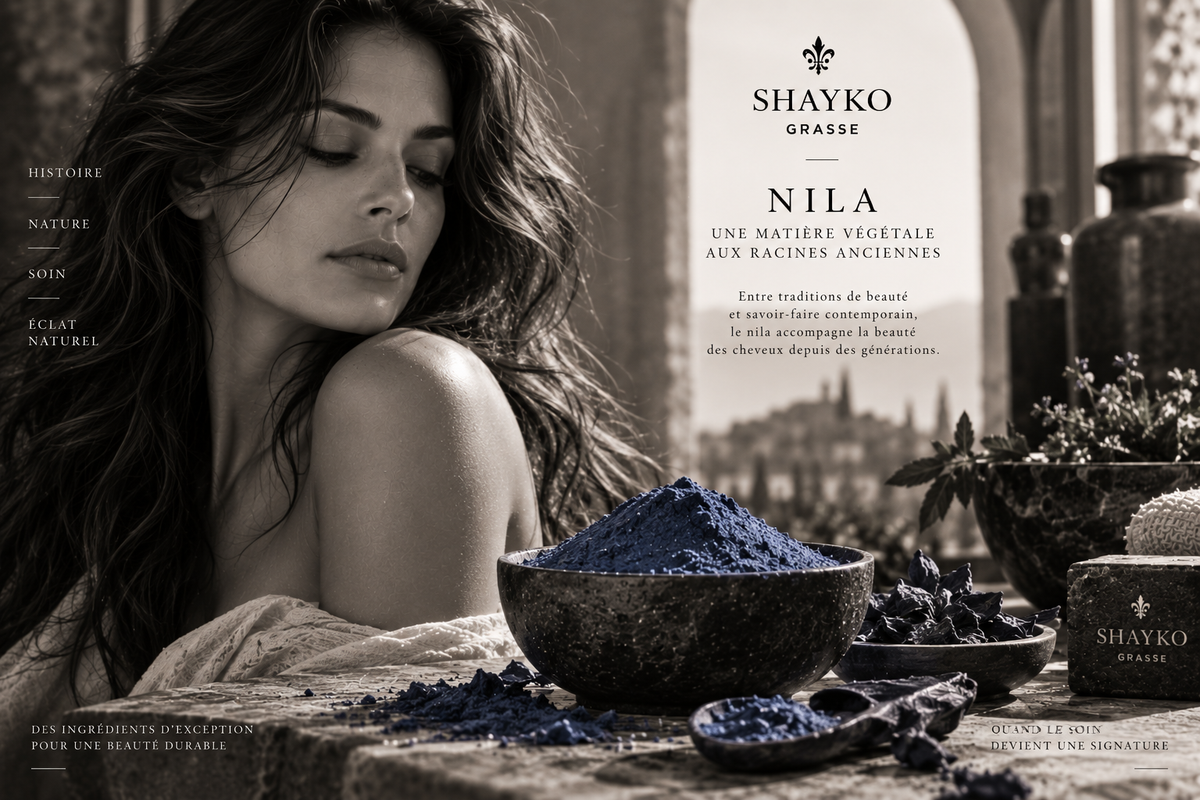
Some materials immediately attract attention.
Nila is part of them.
- Its color.
- Its history.
- Its connection to ancient beauty traditions.
Everything seems to distance it from the shampoo as we know it today.
And yet this plant-based material has now found its place in certain contemporary hair care products.
To understand why, we must begin by looking back at its origin.
What is nila?
The term nila may refer, depending on the traditions and regions, to different plant preparations associated with a naturally colored powder.
This is precisely why caution is needed when discussing this ingredient.
Not all products marketed under the name “nila powder” necessarily have the same botanical origin, preparation method, or composition.
In a formulated cosmetic product, what therefore matters is not only the traditional name of the material.
Its origin, quality, and the way it is incorporated into the formula must be considered.
This precision fully reflects the way we look at ingredients at SHAYKO.
A material deserves to be understood before it is described.
Why is nila associated with hair?
Nila is one of these plant-based materials traditionally used in certain beauty rituals for the skin and hair.
Its interest in hair care is notably associated with supporting the appearance of the fiber and seeking a visually more harmonious head of hair.
But a common confusion should be avoided.
A material used traditionally does not automatically become an active ingredient capable of biologically transforming the hair.
The visible hair is a keratinized fiber.
A cosmetic treatment acts primarily on its environment and surface.
It is within this framework that the contemporary use of nila should be understood.
The beauty of the hair also lies in its surface
We have already mentioned this when discussing silk proteins.
The surface of the hair greatly influences its appearance.
When it is relatively regular, light reflects more harmoniously.
- The hair appears more luminous.
- Softer.
- More polished.
When it becomes irregular due to friction, heat or the various stresses of daily life, the hair can gradually lose this sense of harmony.
Hair care therefore often seeks to support the fiber rather than alter its nature.
Nila belongs to this culture of care when it is incorporated into a coherent formulation.
Does nila color the hair?
This is an important question given the colorful world associated with this ingredient.
However, a plant powder used in certain traditional rituals should not be confused with a hair dye formulated to permanently alter the hair's color.
An ingredient's behavior depends on its exact nature, its concentration, its preparation process and the formula as a whole.
The presence of nila in a shampoo does not therefore automatically mean that it works like a hair dye.
At SHAYKO, we prefer to avoid this kind of shortcut.
An ingredient has a history.
Formulation then determines the product's function.
Tradition and formulation are not opposed
That is probably what interests us most about nila.
Like shikakai or nettle, this ingredient reminds us that hair care did not begin with the modern cosmetics industry.
For generations, different cultures have used the ingredients available in their environment.
- Plants.
- Oils.
- Powders.
- Clays.
- Infusions.
This knowledge has been passed down.
- Sometimes empirically.
- Sometimes culturally.
Contemporary formulation now has other tools.
It makes it possible to select the ingredients.
To exercise greater control over their use.
To combine them.
And to develop products that meet precise requirements for stability, use and sensory qualities.
One must not erase the other.
NILA: an ancient ingredient, a new ritual
It is in this spirit that our NILA solid shampoo was created.
We have kept the name of the ingredient.
Because it carries a story.
But we have given it a contemporary expression.
The solid shampoo transforms the traditional ritual into a different gesture.
- Compact.
- Simple.
- Measured.
The material meets water at the time of use.
The product is taken gradually.
The scalp is massaged.
Then the hair is carefully rinsed.
The past is not reproduced.
It is interpreted.
Why do these materials have a place at SHAYKO?
Because our vision of cosmetics is not about systematically opposing nature and science.
An ancient plant is not interesting solely because it is natural.
A recent technology is not interesting solely because it is modern.
What matters is relevance.
Understanding why a material exists in the formula.
Understanding what it can contribute.
And above all, knowing what it should not be made to promise.
This final part is essential.
Because precision is also part of luxury.
Another way of passing on care
With NILA, SHIKAKAI and SOUFFLE, three botanical stories meet in a single collection of solid shampoos.
Shikakai leads us towards Indian haircare traditions.
The nettle in SOUFFLE brings us back to a plant familiar in our landscapes and in traditional hair preparations.
NILA opens up yet another territory.
- Three materials.
- Three stories.
- But one same idea.
Contemporary care can look to the future without losing the memory of the gestures that came before it.
Perhaps this too is what it means to build a Maison.
Not simply creating products.
Creating connections.
Between materials and gestures.
Between cultures and formulation.
Between what we learned yesterday and what we choose to do with it today.
Because a material becomes truly interesting when we no longer limit ourselves to knowing its name.
We begin to understand its history.
“An ancient material does not ask us to reproduce the past. It invites us to understand what it can still transmit to the present.”
SHAYKO Grasse
Quand le soin devient une signature.