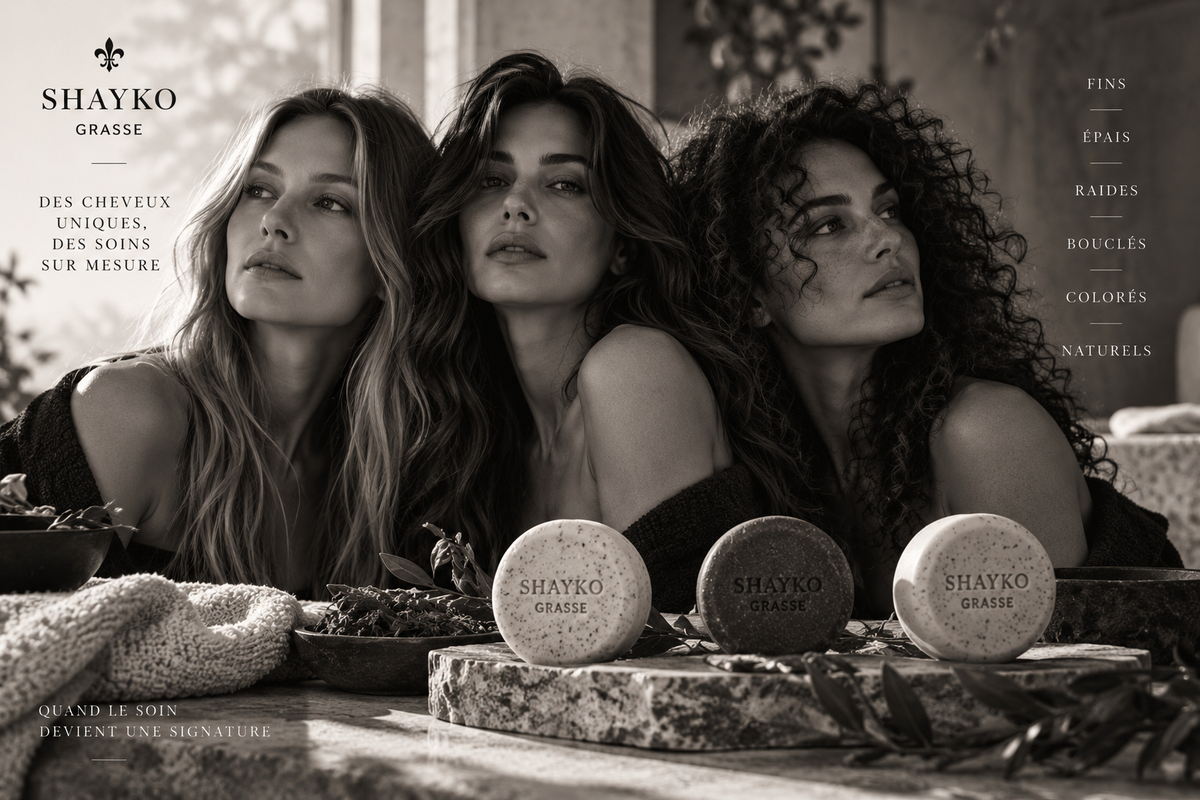
Solid shampoo is sometimes presented as a category of its own.
As if simply being solid were enough to determine which hair it suits.
Yet a bar is only a form.
Behind this form lies a formulation.
- Cleansing agents.
- Powders or plant extracts.
- Texture agents.
- Possibly oils or other ingredients intended to support the treatment.
Two solid shampoos can therefore be as different from each other as two liquid shampoos.
The real question is therefore not:
“Can my hair use a solid shampoo?”
But rather:
“Does this formula meet the needs of my scalp and hair?”
The scalp remains the first criterion
As we saw in our previous articles, shampoo is intended above all for the scalp.
This is where sebum, perspiration, dead skin cells, and residue accumulate.
The primary function of a shampoo, whether liquid or solid, is therefore to cleanse.
But not all scalps behave in the same way.
- Some produce more sebum.
- Others are drier.
- Some become uncomfortable easily.
- The frequency of washing also varies considerably from one person to another.
- Choosing a solid shampoo should therefore begin with this observation.
How does my scalp feel between washes?
And what about the lengths?
They tell a different story.
Someone can perfectly well have a scalp that becomes oily quickly and dry ends.
Relatively normal roots and lengths sensitized by coloring.
Or a comfortable scalp accompanied by very fine hair that becomes weighed down easily.
That is why expressions such as “dry hair” or “oily hair” can sometimes be too simplistic.
- The scalp and lengths should be assessed separately.
- The shampoo primarily addresses the former.
- Complementary treatments can then support the latter.
Fine hair: can solid shampoo be suitable?
Yes.
But fine hair often calls for restraint.
Because their diameter is smaller, some fine hair can quickly lose its movement when weighed down by overly rich products or used in excess.
This does not mean that they need to be washed with highly detergent products.
It is more about finding a balance between cleansing and lightness.
With a solid shampoo, the amount used becomes particularly important.
A few strokes may be enough.
More hair does not necessarily mean greater cleanliness.
What about thick hair?
Thick hair raises another question.
Distribution.
When hair is very dense, it may be more difficult to reach the scalp properly.
- The motion must then be precise.
- Thoroughly wet the hair.
- If necessary, separate sections with your fingers.
- Then gradually distribute the shampoo around the roots.
- There is still no need to rub all the lengths with the bar.
- The scalp remains the priority.
Curly hair: paying particular attention to the lengths
Curly or very wavy hair may have specific needs.
The shape of the hair fiber notably influences how sebum is distributed along the hair.
The lengths may therefore be more prone to a dry feeling.
Here again, this does not at all rule out solid shampoo.
But the formula chosen, washing frequency, and above all the care given to the lengths become particularly important.
Shampoo cleanses.
It should not be expected to meet all of the hair's needs on its own.
What about color-treated hair?
The question requires greater precision.
Coloring changes the characteristics of the hair fiber, and some color-treated hair becomes more sensitive to repeated washing, friction, or certain practices.
The fact that a shampoo is solid does not automatically determine whether or not it is suitable for color-treated hair.
Once again, the formulation matters more than the format.
When hair color requires particular care, it is best to check that the shampoo chosen is compatible with the recommendations associated with that color.
Is a solid shampoo necessarily gentle?
No.
This is a common misconception.
The solid format is often associated with naturalness and, by extension, gentleness.
Yet these concepts are not synonymous.
A solid shampoo can be very gentle.
It may also provide more cleansing power.
It depends in particular on the nature and combination of the cleansing agents, as well as on the formula as a whole.
Conversely, a liquid shampoo can be perfectly formulated for balanced cleansing.
The product's form alone can therefore never be used to assess how gentle it is.
And what about soap used as shampoo?
Two products that are sometimes confused should also be distinguished.
A solid shampoo is not necessarily a soap.
Their formulation may be different.
A solid shampoo can be made with cleansing agents selected specifically for hair use, whereas a soap results from a saponification process.
This difference can notably influence the pH and the product’s behaviour on the hair fibre.
It is therefore preferable to use a product on the hair that has been genuinely formulated for this purpose, rather than assuming that all solid products are interchangeable.
NILA, SHIKAKAI and SOUFFLE: three expressions of the solid format
At SHAYKO, we have chosen not to view solid shampoo as a single formula intended indiscriminately for everyone.
Our collection explores three identities:
NILA.
SHIKAKAI.
And SOUFFLE, our solid nettle shampoo.
Three plant-based worlds shaped by the same conception of the gesture.
- Take out gradually.
- Cleanse mainly the scalp.
- Avoid unnecessary friction on the lengths.
- Rinse thoroughly.
- Then leave the shampoo to dry between uses.
- The material changes.
- The intention may change.
- But the precision of the gesture remains.
How can you tell whether your shampoo is truly suitable?
Ultimately, there are signs that are much more useful than the categories listed on a label.
After washing, the scalp should feel clean and comfortable.
Once dry, the hair should return to a pattern consistent with its nature.
If the roots quickly feel weighed down, the scalp becomes uncomfortable, or the lengths consistently seem difficult to manage, the routine may need adjusting.
- Sometimes, the formula needs to be changed.
- Sometimes, simply use less product.
- Adjust the frequency.
- Or reconsider the way the shampoo is applied.
There is no universal format
Ultimately, this is the answer to our initial question.
Yes, solid shampoo can suit a very wide range of hair types.
But no, not all solid shampoos are necessarily suitable for every hair type.
And this nuance is essential.
At SHAYKO, we prefer this approach to universal promises.
Understand before choosing.
Observe before changing your routine.
And never assuming that a format, an ingredient, or a trend can, on its own, meet every need.
Because the precision of care always begins with understanding what we are truly seeking to support.
“It is not the form of a treatment that determines its suitability, but the meeting between its formulation and the needs of the person using it.”
SHAYKO Grasse
Quand le soin devient une signature.