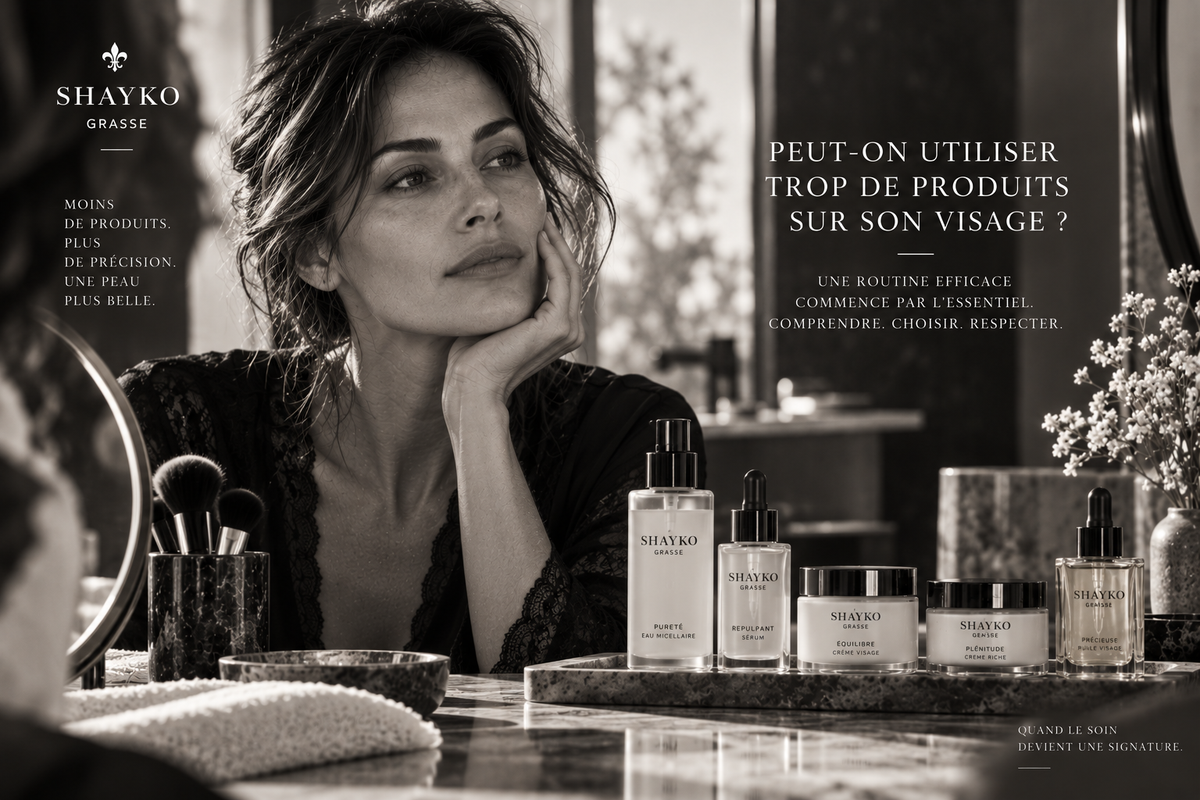
For a long time, caring for your skin meant a few steps.
- Cleanse.
- Hydrate.
- Protect.
Then routines gradually became longer.
- A first serum.
- Then a second one.
- A lotion.
- An essence.
- An exfoliant.
- An oil.
- A mask.
Sometimes several active ingredients during the same routine.
This development has made it possible to better understand ingredients and their functions.
But it has also established a strange idea:
the more steps a routine contains, the more effective it is supposed to be.
Yet the skin does not work this way.
The skin does not count products
Our skin does not know whether we have used three or ten products.
It is simply reacting to what we apply to it.
- The ingredients.
- The concentrations.
- The textures.
- The frequency of use.
- And above all, to their interactions.
Adding a product therefore does not automatically improve a routine.
Each additional step should have a reason to exist.
This is probably the first rule of a precisely constructed routine.
Why do we tend to accumulate products?
Because each product often addresses a different promise.
- Hydrate.
- Brighten.
- Smooth.
- Exfoliate.
- Provide comfort.
- Improve the appearance of pores.
- Address the signs of ageing.
- Taken separately, each one may seem relevant.
The problem arises when we try to address all these concerns simultaneously.
The routine then becomes a succession of corrections.
And sometimes, the skin eventually no longer knows what we are really trying to provide it.
Can several products become redundant?
Yes.
For example, two serums may contain ingredients pursuing very similar goals.
A cream may already provide humectants found in a product applied just beforehand.
An oil may be added even though the cream being used already provides sufficient lipid comfort.
This redundancy is not necessarily dangerous.
It may simply be unnecessary.
And in a precise approach to skincare, the unnecessary also deserves to be questioned.
The real problem: multiplying the demands on the skin
The accumulation becomes particularly problematic when several active products are used simultaneously or too frequently.
- Exfoliants.
- Retinoids.
- Certain blemish treatments.
- Highly concentrated products.
Depending on their nature and use, combining them indiscriminately can increase the risk of irritation, dryness or discomfort.
A permanent tingling sensation is not proof that a product is “working”.
Continuously irritated skin is not skin that is being stimulated effectively.
When the skin barrier begins to protest
We have devoted an entire article to the skin barrier.
This is precisely where the subject takes on its full meaning.
When the skin is overburdened, it can become more uncomfortable.
- Tightness.
- Flaking.
- Redness.
- Unusual sensitivity.
Products that were once perfectly tolerated suddenly beginning to cause an unpleasant sensation.
In this context, adding yet another active ingredient to “repair” the situation immediately is not always the best response.
Sometimes, the first form of sophistication is to simplify.
Is a simple routine less effective?
Absolutely not.
A relatively short routine can perfectly meet the skin’s essential needs.
- Cleanse in moderation.
- Moisturise and provide comfort when necessary.
- Protect the skin from the sun.
- Then, if necessary, introduce a targeted treatment when a specific need warrants it.
- Simplicity is not the absence of expertise.
- It may, on the contrary, be the consequence.
When we understand what the skin needs, we often become able to do less.
But to do it better.
So how many products should you use?
There is no universal number.
Three products may be perfectly suited to one person.
Another person may prefer a slightly more elaborate routine.
So the right question is not:
“How many products should I use?”
But:
“What is the purpose of each product I use?”
If the answer becomes difficult, the routine may need to be reconsidered.
Morning: focus on the essentials
In the morning, the skin does not necessarily need an endless succession of layers.
Depending on its needs, the routine can remain very simple.
- Appropriate cleansing when necessary.
- A serum if it serves a purpose that is genuinely sought.
- A moisturising, comfortable texture.
- Then, appropriate sun protection.
The goal is not to include every possible step.
It is about preparing and protecting the skin for the day.
Evening: more does not always mean better
The evening offers more time.
This can make you want to add more steps.
But here again, the skin does not need to be exfoliated, masked, and treated every night as a matter of course.
Above all, evening is the time to remove what has built up throughout the day.
- Makeup.
- Sun protection.
- Sebum.
- Particles and impurities.
- Then comes skincare.
- Sometimes a serum.
- A cream.
- Possibly an oil when the skin is seeking greater comfort.
That may be enough.
Do you need to use all your products every day?
No.
This is another important idea.
Having several skincare products does not mean having to use them all at the same time.
- An oil can be reserved for periods when the skin becomes drier.
- A rich cream can take over in winter.
- An exfoliant can be used occasionally rather than daily.
- A mask can remain an occasional step.
A routine can therefore be modular.
It evolves with the skin instead of imposing the same protocol on it every day.
Should skincare change with the seasons?
Often, yes.
- We saw this with textures.
- Cold and dry air can increase the need for comfort.
- Heat can make certain textures less pleasant.
- Habits change too.
- An intelligent routine therefore accepts that it should not be fixed.
- It has a structure.
- But it knows how to adapt.
And when introducing a new product?
Patience becomes particularly useful.
Introducing several new products at the same time makes it difficult to identify what is truly right for the skin.
If a reaction appears, which product is responsible?
If the skin improves, which one actually made a difference?
Introducing products gradually makes observation possible.
And observation is at the heart of a precise routine.
At SHAYKO, a collection is not a prescription
This is an essential distinction.
Our Face universe comprises several skincare gestures.
CLARTÉ for makeup removal.
PURETÉ for micellar cleansing.
REPULPANT in the serum world.
CONFORT for the lightness of the fluid.
ÉQUILIBRE, GALBE, RESSOURCE and PLÉNITUDE for different expressions of the cream.
PRÉCIEUSE for the oil application.
But presenting several skincare products does not mean asking everyone to use them all.
A collection offers possibilities.
It should never become an obligation to accumulate.
Building your routine like a wardrobe
You can almost imagine skincare as a wardrobe.
We do not wear all our clothes at the same time.
We choose according to the season.
- The moment.
- The need.
- The occasion.
Skin can work in the same way.
- A fluid today.
- A more enveloping cream when the climate changes.
- An oil when greater comfort is desired.
- The product remains available.
But the gesture adapts.
This freedom seems much more modern to us than a rigid ten-step routine.
Sensory appeal can also lead to excess
A pleasant treatment naturally makes you want to use it.
It is even one of the important dimensions of cosmetics.
- Texture.
- Fragrance.
- Gestures.
- Pleasure.
But the pleasure of the ritual does not necessarily have to become multiplication.
A few carefully chosen steps can create a much more elegant experience than the mechanical accumulation of products.
Luxury also lies in the space left between things.
And what if the skin is doing perfectly well?
So perhaps there is nothing to add.
This answer seems almost too simple in a world that continually encourages us to seek a new correction.
Yet comfortable skin does not need us to constantly invent a new problem for it.
Maintaining its balance is already a form of care.
Preserve rather than correct.
Support rather than overstimulate.
It is a different philosophy.
Haute Cosmétique de Précision also begins with removal
At SHAYKO, we speak of Haute Cosmétique de Précision.
Precision is not limited to selecting an ingredient or developing a texture.
It also concerns the way the product is used.
- Choose what is necessary.
- Understand why it is used.
- Observe the result.
- Then knowing when to remove a step that has become unnecessary.
Because a sophisticated routine is not the one with the greatest number of products.
It is one in which every product earns its place.
Less, but never less well
This is not about defending minimalist cosmetics as a principle.
- Some skin types benefit from several steps.
- Certain needs require targeted care.
- And the ritual also has a personal dimension.
It is simply a matter of replacing a quantitative approach with one based on coherence.
No longer asking:
“What else can I add?”
But:
“Does my skin really need this step?”
This question changes everything.
Because it places the skin at the centre of the ritual.
And perhaps true luxury begins precisely here.
In the ability to choose.
In giving up what is unnecessary.
And in keeping only what has a reason to exist.
“Sophistication does not lie in the number of steps, but in the precision of each one.”
SHAYKO Grasse
Quand le soin devient une signature.