We often speak about skin aging through what we see.
- A wrinkle.
- A loss of firmness.
- A change in the oval of the face.
- A few spots.
- Skin that appears drier than before.
But these visible signs are merely the surface of a much more complex evolution.
Because over the years, it is not only the skin’s appearance that changes.
Its functioning also changes.
Understanding this transformation allows us to view skincare differently.
No longer seeking to erase time.
But learning to support the skin as its needs change.
The skin is living tissue
The skin is constantly renewed.
Cells are born, develop, and then gradually contribute to forming the superficial layers of the epidermis.
In the dermis, other structures contribute to the skin’s strength, suppleness, and overall architecture.
All of this forms an extremely sophisticated biological system.
But like the rest of our body, its functioning changes over time.
Certain processes gradually become slower.
Certain substances are produced in smaller quantities.
The organization of the tissues changes.
This change is natural.
Skin renewal changes
Young skin generally has relatively dynamic cell renewal.
With age, this process tends to slow down.
Superficial cells may then remain on the surface for longer.
The skin’s texture may gradually seem different.
- Less even.
- Sometimes duller.
This is one of the reasons why the complexion can change over the years.
But that does not mean exfoliation should be increased.
Skin with slower renewal may also be more vulnerable.
Once again, stimulating more is not always synonymous with taking better care.
What happens to collagen?
Collagen is one of the dermis’s major structural proteins.
It contributes to the skin’s strength and architecture.
Over time, its production and organization change.
Various environmental factors can also accelerate its degradation.
Gradually, the skin may lose some of its firmness.
- The contours of the face change.
- Some wrinkles become more visible.
- It is a slow process.
- And above all, perfectly natural.
We will also devote a dedicated article to collagen, as this protein is now the subject of many sometimes excessive cosmetic claims.
And elastin?
Elastin contributes to the elastic properties of tissues.
It contributes to their ability to regain their shape after deformation.
Its organization also changes over time and under the influence of external factors.
- Collagen and elastin are often mentioned together.
- But they do not play exactly the same role.
- The skin’s firmness, suppleness, and appearance result from a combination of structures, not a single molecule.
This is why reducing skin ageing to “a lack of collagen” would be too simplistic.
Why does the skin often become drier?
This is one of the most frequently observed changes.
With age, sebum production may decrease.
The skin’s lipid composition may also change.
The skin barrier may then have greater difficulty maintaining the same level of comfort as before.
A lightweight cream used for years may suddenly seem insufficient.
The skin requires more lipids.
A more enveloping texture.
Or simply a less aggressive routine.
This explains why skincare must evolve with the skin.
The hyaluronic acid naturally present in the skin also changes
Hyaluronic acid is not only a cosmetic ingredient.
It is naturally present in various tissues throughout our body, particularly in the skin.
It contributes to their water-rich environment.
With age, its quantity, distribution, and metabolism change.
This contributes to gradual changes in the skin’s hydration and mechanical properties.
But applying a treatment containing hyaluronic acid is not the same as directly replacing the hyaluronic acid naturally found in the dermis.
Cosmetic action takes place primarily in the superficial layers of the skin.
This distinction is important to avoid unrealistic promises.
Why do wrinkles appear?
- A wrinkle does not have a single cause.
- Some are linked to repeated facial movements.
- Smiling.
- Frowning.
- Squinting.
Others gradually become more visible as the skin’s structure changes.
Added to this are dehydration, loss of suppleness, and environmental effects.
A small superficial fine line linked to a lack of water is therefore not exactly the same as an established wrinkle.
The word “wrinkle” covers several different realities.
The sun plays a major role
Skin aging is not determined solely by the passage of time.
A significant proportion of visible signs is influenced by our environment.
Repeated exposure to ultraviolet radiation plays a major role in what is known as photoaging.
It can contribute to the appearance of pigmentation spots, changes in texture and the progressive deterioration of certain dermal structures.
That is why sun protection plays such an important role in a preventive routine.
Far more than the constant pursuit of the latest spectacular active ingredient.
And what about lifestyle?
The skin does not exist independently of the rest of the body.
- Smoking, lack of sleep, certain dietary habits, stress and various environmental exposures can all influence its appearance.
- But another form of excess should also be avoided.
Aging skin is not necessarily the result of a poor routine or lifestyle.
Aging is a normal biological process.
Skincare can support this process.
It can neither claim nor seek to abolish it.
Mature skin is not a single skin type
This is an essential distinction.
Not all skin ages in the same way.
Mature skin may be dry.
- Combination.
- Still relatively oily.
- Thin.
- Thick.
- Sensitive or particularly resilient.
There is therefore no single texture intended for everyone of a certain age.
That is why we prefer to observe the skin rather than the date of birth.
Should more products be used with age?
Not necessarily.
Needs may change.
But this does not mean that the routine needs to become longer.
- Appropriate cleansing.
- Consistent hydration.
- A texture providing sufficient comfort.
- Actives chosen with discernment.
- And appropriate sun protection.
A relatively simple routine can be perfectly sophisticated when it is well designed.
Accumulation can never replace consistency.
What role can cosmetics really play?
Cosmetics can affect the skin’s appearance and comfort.
It can support its hydration.
- Improve its feel.
- Provide lipids.
Help create a smoother or brighter appearance, depending on the formulations.
Some active ingredients also have documented effects on various visible signs of aging.
But a cream cannot stop time.
And it does not need to promise this to have value.
For us, this distinction is essential.
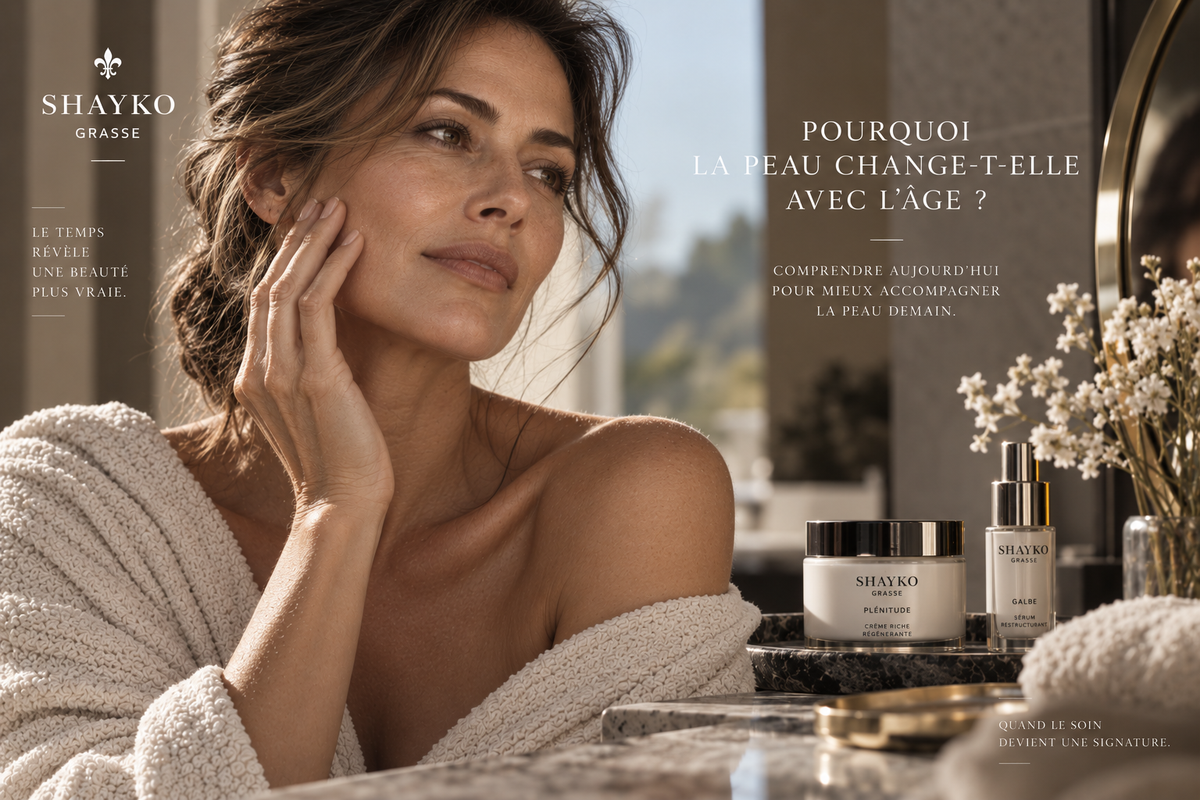
GALBE, RESSOURCE and PLÉNITUDE: accompanying rather than correcting
In the SHAYKO Face range, certain textures naturally find their place as the skin’s expectations evolve.
GALBE is part of the pursuit of suppleness and visibly harmonious skin.
RESSOURCE accompanies the evening ritual.
PLÉNITUDE responds to the search for more enveloping comfort when the skin calls for greater richness.
These skincare products do not correspond to prescribed ages.
They correspond to needs.
A 45-year-old woman may prefer PLÉNITUDE.
Another 65-year-old woman may feel perfectly comfortable with a lighter texture.
Precision begins when we stop automatically associating an age with a product.
At SHAYKO, we do not want to fight time
This idea is fundamental to our vision of beauty.
Cosmetic vocabulary has long used expressions such as:
- anti-aging,
- anti-wrinkle,
- correction,
- flaw,
- imperfection.
As if the passage of time were something that necessarily had to be concealed.
We prefer another way of looking at it.
- The face evolves.
- Its architecture changes.
- Its expression grows richer.
- And skincare evolves with it.
Caring for mature skin does not mean asking it to become what it was twenty years ago.
It consists in allowing it to be as comfortable, harmonious and radiant as possible today.
Time is not beauty’s enemy
Young skin has a particular beauty.
Mature skin does too.
They simply do not tell the same story.
At SHAYKO, we believe cosmetics reach a form of maturity when they stop promising the impossible.
- It can accompany.
- Preserving.
- Improving appearance.
- Providing comfort.
- Supporting a ritual.
- But it must also respect what time builds.
- An expression.
- A story.
- A distinctive quality.
Because perhaps true precision does not consist in erasing the years.
It consists in understanding what they change in order to adapt the skincare intelligently.
“Time does not take away the beauty of skin. It changes its needs and gives it another story to tell.”
SHAYKO Grasse
Quand le soin devient une signature.