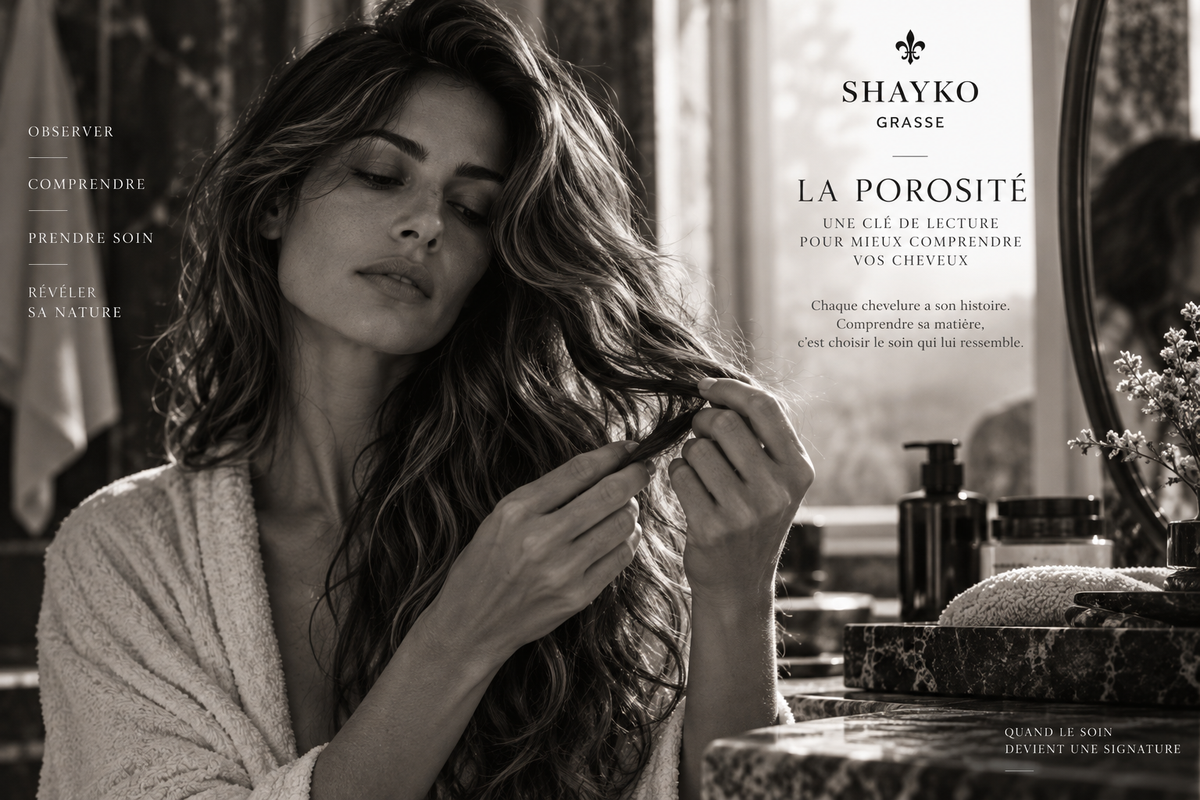
In the world of hair care, certain terms suddenly appear everywhere.
- Porosity is one of them.
- Low porosity.
- Medium porosity.
- High porosity.
Many recommendations even suggest building an entire routine around this single characteristic.
The concept is real.
But as is often the case in cosmetics, reality is more nuanced than the classifications found on social media.
To understand porosity, we must first look at the hair itself.
The hair fibre has an architecture
The visible part of the hair is mainly made up of keratin.
Its structure comprises different layers.
On the outside is the cuticle.
It is made up of flattened cells that overlap like small scales.
This envelope plays an essential role.
It protects the internal structures of the fibre and directly influences its behaviour in response to water, products and external damage.
When we talk about porosity, we are particularly interested in how this structure allows water to penetrate the fibre and leave it again.
What is porous hair?
Hair with a more damaged surface can allow water to penetrate more easily.
But it can also lose it more quickly.
That is the paradox.
Highly porous hair can quickly absorb moisture without necessarily retaining it for long.
- The fibre may then feel dry.
- Rough.
- More difficult to manage.
- Or become more sensitive to changes in ambient humidity.
Porosity is therefore not simply the hair’s ability to “drink up” a product.
It describes a much more complex behaviour of the fibre.
Why does some hair become more porous?
Porosity has a natural dimension.
Hair structure varies from person to person.
But it can also change over time.
- Colouring.
- Bleaching.
- Chemical straightening.
- Repeated use of heated appliances.
- Sun exposure.
- Friction.
- Repeated brushing.
All these stresses can gradually damage the surface of the fibre.
And it is important to remember one fundamental characteristic of hair.
The visible length does not regenerate like skin.
An end located several dozen centimetres from the scalp already has a long history.
The ends can therefore be more porous than the roots
That is perfectly logical, in fact.
The first few centimetres closest to the scalp are relatively recent.
The ends, meanwhile, may be several years old.
- They have undergone more washing.
- More blow-drying.
- More sun exposure.
- More friction.
- A single head of hair can therefore have several surface conditions.
And this is an additional reason not to consider hair as a perfectly uniform material from roots to ends.
Does low porosity mean perfectly healthy hair?
Not necessarily.
This is another common simplification.
Low porosity mainly indicates that the fiber allows water to penetrate less easily.
On its own, this does not constitute a diagnosis of the hair’s “good health.”
Similarly, higher porosity alone cannot determine the overall condition of a head of hair.
- Diameter.
- Shape.
- Density.
- Chemical treatments.
- Sebum production.
- Styling habits.
All these factors also matter.
Porosity is therefore one observation among others.
Not a definitive hair identity.
Is the famous glass-of-water test reliable?
You may already have seen this method.
A strand of hair is placed in a glass of water.
If it floats, it would be low-porosity.
If it remains in the middle, its porosity would be average.
If it sinks, it would be highly porous.
The problem is that many factors can influence the result.
The presence of sebum.
Product residue.
The diameter of the hair.
The water’s surface tension.
The way the hair is placed.
This at-home test therefore cannot accurately establish the porosity of a head of hair.
It may seem spectacular.
You simply should not assign it a value it does not possess.
Observing your hair is often more useful
Certain signs can nevertheless help you understand how the hair fiber behaves.
- How does the length react when wet?
- Does the hair become rough easily?
- Do the ends seem particularly dry?
- Does the hair react strongly to humidity?
- Does hair care seem to weigh the fiber down quickly?
- Has the hair been regularly colored or bleached?
These observations often reveal more than a test carried out with a single hair.
Should you choose your shampoo according to your hair’s porosity?
Not only.
Shampoo is primarily intended for the scalp.
Porosity mainly concerns how the hair fiber behaves.
It would therefore be reductive to choose your shampoo solely based on an assumed level of porosity.
For shampoo, you must first observe the scalp.
- Its sebum production.
- Its washing frequency.
- Its comfort.
The lengths can then receive care suited to their condition and behaviour.
This distinction helps avoid expecting a single product to address every issue.
Can a porous fibre be “repaired”?
The word repair must also be used precisely.
The visible part of the hair is a keratinised material that does not have the biological ability to permanently rebuild damaged areas as living tissue could.
By contrast, hair products can act on the surface of the hair fibre.
They can help improve its feel.
- Its appearance.
- Its suppleness.
- Its ease of styling.
- And limit certain mechanical stresses.
- The result can be highly visible.
But this is a cosmetic effect on the hair fibre, not biological regeneration of the hair.
This distinction is essential.
Hair care begins by limiting unnecessary damage
When the lengths become highly porous, adding products is not always the only answer.
- Habits must also be considered.
- Excessive hair-dryer heat.
- Very frequent use of straighteners.
- Vigorous rubbing with a towel.
- Aggressive brushing.
- Repeated bleaching.
- Prolonged sun exposure.
Hair care sometimes consists as much in avoiding a constraint as in adding a product.
This is a philosophy we particularly uphold at SHAYKO.
Understanding rather than classifying
Porosity is therefore a useful concept.
It helps us better understand why two heads of hair can react very differently to the same product.
But it should not become another absolute rule.
We are not simply “low porosity” or “high porosity.”
- Hair evolves.
- The roots and ends may be different.
- The seasons change.
- So do habits.
At SHAYKO, we therefore prefer to consider porosity as a way of understanding.
An additional piece of information that helps you observe the structure more closely.
Because knowing your hair does not mean assigning it a label.
It means gradually understanding how it behaves.
And it is precisely when we begin to understand the structure that care becomes more appropriate.
“Knowing your hair does not mean confining it to a category, but understanding how its structure evolves.”
SHAYKO Grasse
Quand le soin devient une signature.