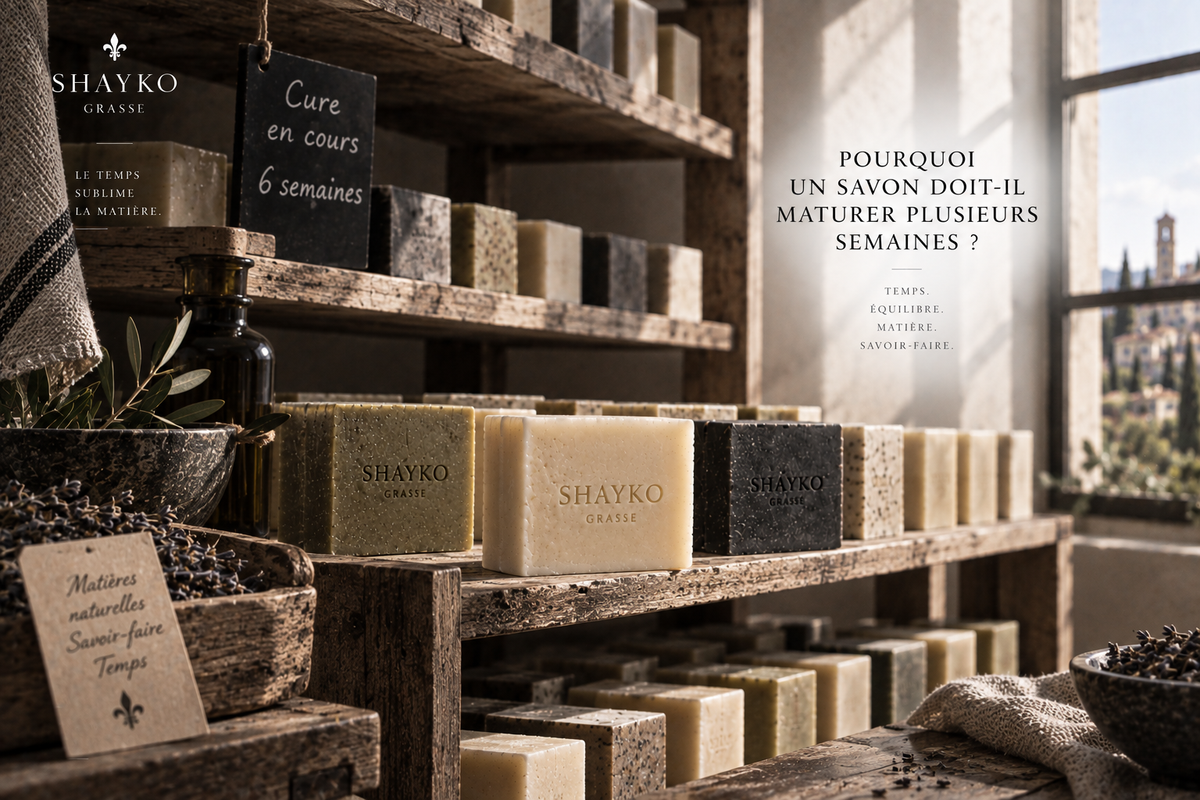
A bar of soap can seem finished without actually being so
The soap has just been removed from its mould.
Its shape is there.
Its colour, too.
It may already bear its imprint and look almost exactly as it will when it reaches a bathroom.
Visually, everything seems finished.
Yet, in cold-process soapmaking, a new period begins.
The soap will be placed in conditions that allow it to mature and dry for several weeks.
This period has a name:
curing.
And it reminds us of one essential thing: the final appearance of a material does not always mean that its evolution is complete.
What exactly is curing?
Curing is the period during which soaps are kept after they are made, before they are used or put on the market.
They are generally arranged in such a way as to allow good air circulation around them.
During this period, several processes continue.
Saponification is completed after the initial production, while some of the water present in the soap gradually evaporates.
It is primarily this reduction in water and the physical evolution of the bar that explain the importance of an extended curing period.
The soap therefore changes without necessarily requiring us to intervene.
Time works together with the material.
Why does soap still contain water?
Water plays an important role during production.
It helps prepare the alkaline solution needed for saponification and makes the mixture easier to work with.
But not all of this water is meant to remain in the soap indefinitely.
Once the bar has been made and exposed to the air under suitable conditions, some of this water evaporates.
The soap then gradually loses weight.
Its structure becomes firmer.
Its surface changes.
The material we held a few days after it was made is therefore not exactly the same several weeks later.
Why is drier soap generally harder?
The explanation is quite intuitive.
The less water the bar contains, the firmer it tends to become.
This hardness has a very tangible consequence during use.
A bar of soap that still contains a lot of water can soften more quickly when it comes into contact with water and wear away more.
A properly matured soap generally holds up better.
This does not mean that a soap must become extremely hard to be of good quality.
Hardness also depends on its formulation and the fats used.
But curing helps this characteristic develop.
Curing can therefore influence how long it lasts
This is a particularly interesting aspect.
When we talk about the lifespan of a solid soap, we often think only of its weight.
Yet two soaps of the same weight can behave differently.
- The formulation matters.
- How they are used matters.
- How they are stored matters.
- And their water content also matters.
A properly dried bar can withstand use better than a bar that is still very wet.
Thus, part of the soap’s longevity is established even before its first use.
Is curing used to “eliminate the lye”?
This is a formulation that is sometimes encountered.
It should be corrected.
In a correctly calculated formula and a controlled process, the alkaline base reacts with the fats during saponification.
The curing period of several weeks should therefore not simply be presented as a period intended to “make the lye disappear”.
The main chemical transformation takes place much earlier.
The long curing period plays a particularly important role in the evaporation of water and the physical maturation of the soap.
This distinction is important because it helps us understand the process rather than turn it into an approximate narrative.
Four weeks? Six weeks? Longer?
There is not necessarily a single duration that applies to all soaps.
Curing periods of several weeks are frequently encountered in cold-process soapmaking, often around four to six weeks, but some formulations may benefit from a different or longer maturation period.
Why?
- Because not all soaps are identical.
- The amount of water used.
- The type and proportion of fats.
- The size of the soaps.
- The drying conditions.
- The humidity and temperature of the environment.
- All these parameters can influence how they develop.
The schedule must therefore remain at the service of the material, not the other way around.
Can time be accelerated?
Contemporary manufacturing naturally makes it possible to control many parameters.
But accelerating a process is only worthwhile if the desired result remains controlled.
In traditional cold-process soapmaking, curing is part of the very identity of the process.
It allows water to gradually leave the bar under suitable conditions.
It is therefore not simply a matter of waiting out of fidelity to tradition.
Time has a concrete function here.
How are the soaps arranged during this period?
Air circulation is important.
The soaps must be able to gradually lose their moisture.
They are therefore generally arranged with enough space between them, on supports suited to the production method.
In a workshop, this period offers a distinctive sight.
Rows of soaps.
Motionless.
Steady.
Almost silent.
Nothing seems to happen.
And yet, each one evolves slowly.
This may be one of the least spectacular stages of production.
And one of the most beautiful to observe.
Does soap continue to lose water after curing?
Yes, a solid soap can continue to evolve over time depending on its storage conditions.
It may still lose a certain amount of moisture and become harder.
This helps explain why some soaps stored for a long time in good conditions may perform exceptionally well in use.
But this should not lead to the conclusion that a soap becomes indefinitely « better » with age.
Perfuming materials, unsaponified fats and other components may also evolve.
The aim therefore remains controlled maturation, not an unlimited wait.
And the fragrance during this period?
The fragrance is also part of this evolving material.
After production, its expression may change.
Certain notes may seem different between a freshly made soap and a bar that has reached the end of its maturation.
Time, air, the formulation and perfuming materials all play a role in this evolution.
This is why the olfactory work of a soap cannot always be assessed solely when the batter leaves the mold.
It is also necessary to understand what the creation will become.
In Grasse, this relationship between raw material and fragrance naturally takes on a particular dimension.
Curing is not a luxury argument
Waiting six weeks is not, in itself, a sign of luxury.
A long wait does not automatically turn a manufacture into an exceptional product.
What matters is understanding why we wait.
If the material requires time, true savoir-faire consists in giving it that time.
Value therefore does not lie in the number of weeks displayed.
It lies in mastering the process.
This is an essential distinction for SHAYKO.
We do not want to make spectacular what simply falls under work well done.
Time is not always inaction
Our era readily associates efficiency with speed.
- Produce faster.
- Deliver faster.
- Create faster.
But certain transformations remind us that waiting can also be an action.
During curing, no one continually shapes the soap.
Yet the process moves forward.
The water evaporates.
The material becomes firmer.
The object gradually settles into its form for use.
Time then becomes a tool that cannot be held in the hand.
From the laboratory to the bathroom
When the soap finally reaches the person who will use it, this entire period is invisible.
We simply see a square.
- We pick it up.
- We add water.
- The lather appears.
- Then we put it down again.
But before those few seconds of use, several weeks may have been necessary.
This disproportion is fascinating.
Weeks of maturation to make natural a gesture that will take only a few moments.
That, too, is savoir-faire:
make the process disappear behind the simplicity of use.
Letting time do exactly what it needs to do
Ultimately, curing teaches us something that goes beyond soap.
Not every stage of a creation needs to be accelerated.
Some require intervention.
Others require precision.
And some simply require us to know how to wait.
Not out of nostalgia.
Not to artificially construct a story.
But because the material itself requires it.
In the making of cold-process soap, time is therefore not a poetic extra.
It is part of the process.
“During curing, the hand stops, but the material continues its work. Time then becomes one of the soapmaker’s silent tools.”
SHAYKO Grasse
Quand le soin devient une signature.