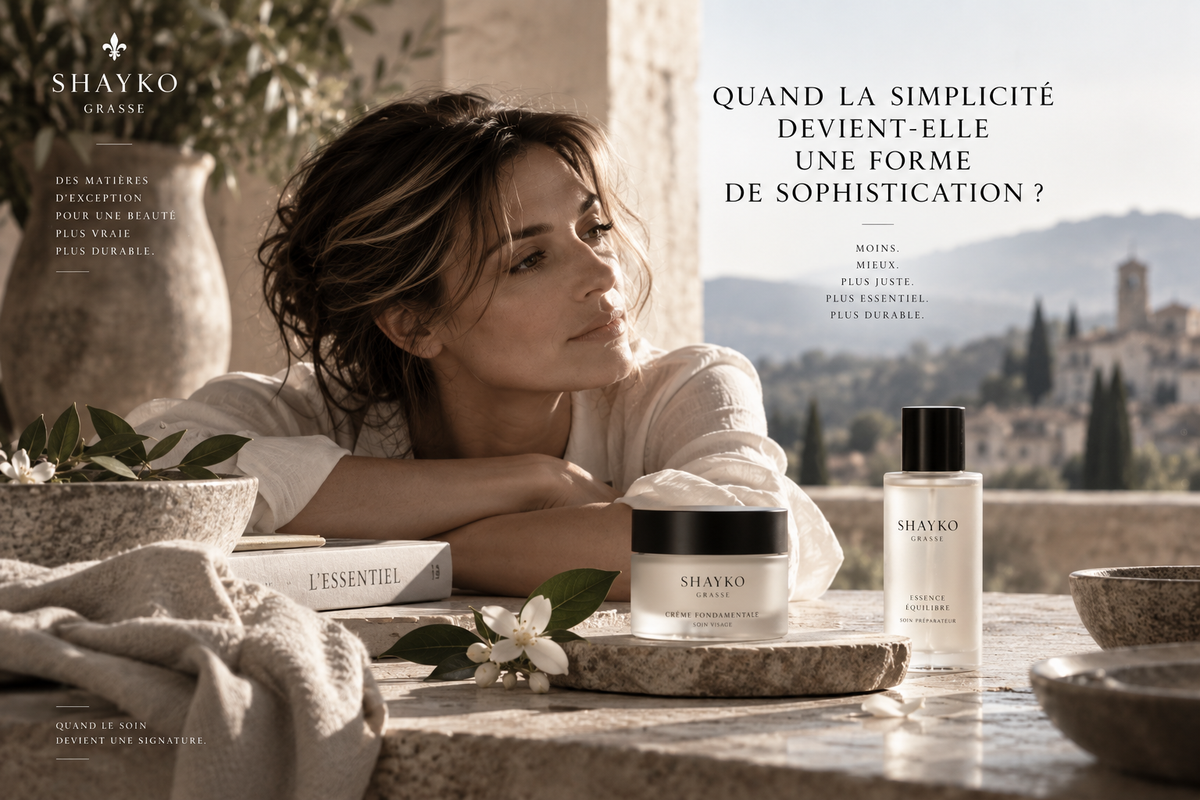
We have learned to associate sophistication with complexity
For a long time, luxury was expressed through abundance.
The richness of ingredients.
The multiplication of details.
The complexity of products.
The profusion of steps.
Cosmetics have not escaped this logic.
Routines have grown longer. Active ingredients have multiplied. Language has become more technical. And the number of steps has sometimes come to be confused with the quality of care.
Yet one question is worth asking:
do we really need everything we can use?
Simplifying does not mean impoverishing
Simplicity can easily be misunderstood.
- A simple formula is not necessarily rudimentary.
- A short routine is not necessarily insufficient.
- An understated product is not necessarily less elaborate.
Simplifying instead means identifying what truly has a function, then giving each element enough space to express it.
- This distinction is important.
- Because removing at random impoverishes.
Removing with discernment brings clarity.
The real work sometimes begins when we remove
Creating naturally means adding.
An ingredient.
A texture.
A fragrance note.
A function.
But there comes a point when the question must be reversed.
What can we remove without losing the original intention?
This step can be particularly demanding.
Because it requires distinguishing what is truly necessary from what is merely appealing.
An ingredient may be remarkable and yet serve no purpose in a specific formula.
A step may seem interesting and add nothing to a particular routine.
A detail can be beautiful and disrupt an object's balance.
Mastery also begins with the ability to do without.
A formula is not a demonstration
Contemporary cosmetics offer an extraordinary wealth of ingredients.
Acids, peptides, plant oils, botanical extracts, antioxidants, humectants, proteins and many other families of ingredients allow formulators to create vastly different skincare products.
This richness is precious.
But it also creates a temptation: to bring everything together.
A formula does not need to demonstrate the full extent of what exists.
It must serve an intention.
The question is therefore not:
“How many active ingredients can we add?”
But rather:
“What does this formula actually need?”
The skin does not necessarily need a long routine
The same principle applies to the daily routine.
- Cleanse.
- Provide comfort when the skin calls for it.
- Protect it when it is exposed.
- Then, if necessary, add according to its needs.
- A routine can sometimes be remarkably short.
- At other times, it will require more attention.
Precision consists precisely in not turning a method into a universal rule.
The skin evolves.
Skincare should be able to evolve with it.
Adding a product should always have a reason
It is easy to build a routine through accumulation.
- One product calls for another.
- Then another.
- Until the ritual becomes difficult to understand.
In this situation, it can sometimes become impossible to know what truly provides comfort, what is superfluous or what is unsuitable.
Simplicity then has a considerable advantage:
it makes skincare easy to understand.
- Each gesture regains a function.
- Each texture finds its place again.
And one can better observe how the skin reacts.
Sophistication can be invisible
A texture that feels perfectly natural under the fingers may have required numerous trials.
A very discreet fragrance may be more difficult to balance than a dominant olfactory presence.
Visually pared-back packaging may require dozens of decisions concerning proportions, materials and typography.
The final simplicity therefore does not necessarily reveal the amount of work that preceded it.
In fact, it is often the opposite.
The more obvious the result seems, the less it reveals the hesitations that made it possible.
The obvious is difficult to create
We sometimes immediately recognize a well-proportioned object.
- We do not necessarily know how to explain why.
- Nothing seems to draw excessive attention.
- Everything seems to be in its place.
- This sensation also exists in cosmetics.
- A texture corresponds to the gesture.
- The fragrance accompanies without overwhelming.
- The container naturally allows the right dosage.
- The formula delivers exactly the desired sensation.
- No element seeks to prove that it is more important than the others.
- The whole becomes coherent.
And this consistency produces something rare:
the obvious.
Silence can belong to luxury
Luxury does not always need immediately recognizable signs.
- It can be silent.
- A material that feels pleasant when the hand encounters it.
- A precise closure.
- A paper whose feel is discovered by touch.
- A formula whose texture disappears at exactly the right moment.
- A fragrance that is perceived more when one draws closer.
- These details do not necessarily seek to impress.
- They are there to be discovered.
This conception of luxury seems particularly contemporary to us.
Less to demonstrate. More to make one feel.
Simplicity requires confidence
Accumulating is reassuring.
More ingredients can give the impression of greater effectiveness.
More words can give the impression of greater expertise.
More decoration can give the impression of greater luxury.
Removing, on the contrary, requires a certain degree of confidence.
Confidence in the formula.
In the product.
In the gesture.
And ultimately in the person who will use it.
Everything does not need to be explained at the same moment.
Every element does not need to seek attention.
A Maison can also leave room.
Precision is a form of simplicity
Precision does not mean systematically reducing.
It consists in retaining only what has a justification.
Sometimes, this will lead to a relatively streamlined formula.
Sometimes, a more complex architecture will be necessary.
So it is not quantity that interests us.
It is coherence.
Simplicity is not a formulation rule. It is a discipline of thought.
What if tomorrow’s luxury were calmer?
Our lives are surrounded by demands for our attention.
- Images.
- Messages.
- New products.
- Trends.
- Promises.
In this context, true privilege could gradually become something else.
- Calm.
- Clarity.
- Time.
- The possibility of choosing less, but better.
Cosmetics can contribute to this evolution.
Not by abandoning innovation or science.
But by using their power with greater discernment.
Our vision of simplicity
At SHAYKO, we do not consider simplicity an aesthetic to reproduce.
It belongs more to our way of thinking.
- Understand before adding.
- Choose before accumulating.
- Formulate before promising.
And leaving enough space for the materials, texture and gesture to express themselves.
This pursuit aligns with our vision of the Haute Cosmétique de Précision.
Cosmetics in which sophistication is not necessarily visible at first glance.
But is discovered gradually.
- In the formula.
- In the touch.
- In the fragrance.
- In the object.
And above all in that difficult-to-define feeling when nothing seems to be missing and nothing appears superfluous.
“Simplicity is not what remains when less has been done. It is what appears when enough work has been done to retain only what is essential.”
SHAYKO Grasse
Quand le soin devient une signature.