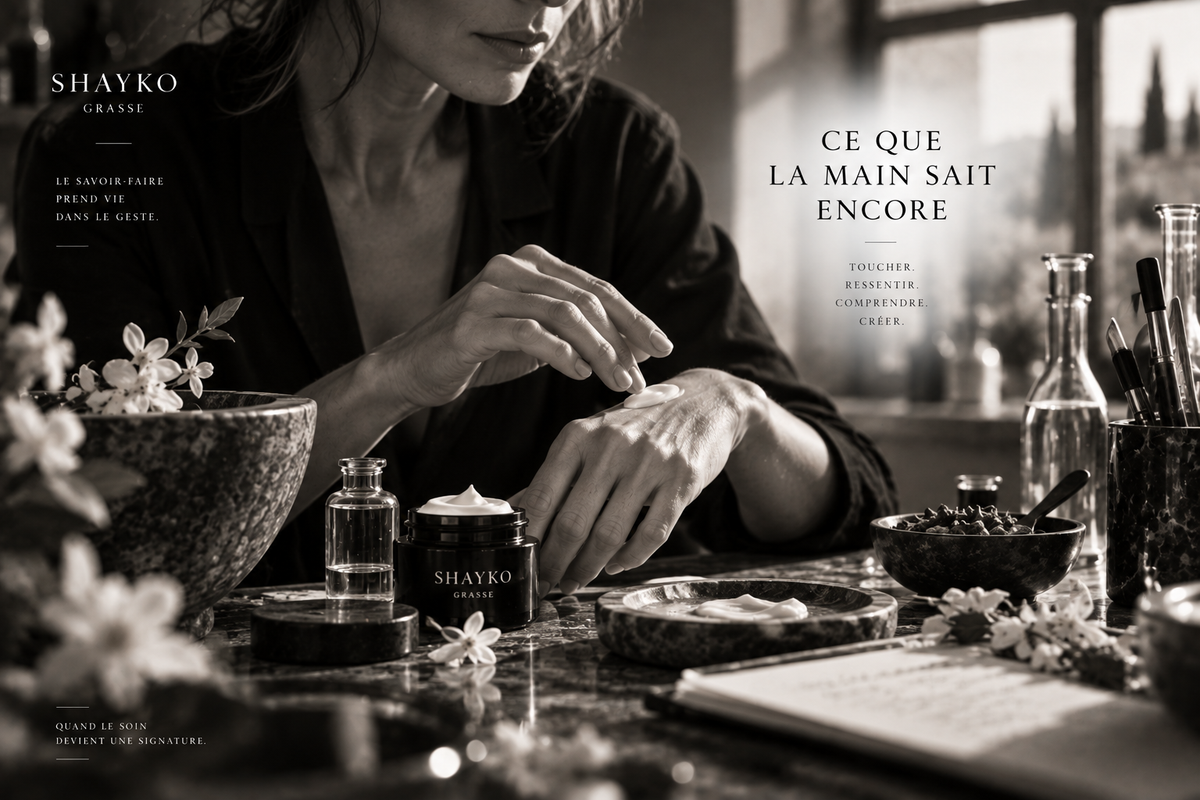
Before instruments, there was the hand
Long before we could precisely measure viscosity, stability, or a formula's characteristics, human beings were already learning through touch.
- Pressed a seed.
- Crumpled a sheet.
- Worked with a material.
- Observed its resistance.
- Recognized its transformation between the fingers.
A considerable part of this expertise was built in this way: through repetition, observation, and transmission.
Today, cosmetics have access to infinitely more precise tools.
And this is an essential evolution.
But this scientific precision did not make the hand unnecessary.
It simply gave it a different place.
Touch is a form of knowledge
We often think that knowing means being able to measure.
Yet certain information is perceived first.
A texture may seem dense in its container, then become surprisingly light when it meets the skin.
An oil may glide for a long time or disappear quickly.
A cream may offer initial resistance before transforming under the gesture.
These sensations are difficult to sum up in a single number.
They belong to what is known as sensoriality.
And the hand is one of its first instruments.
The skin sometimes understands before words
When we try a skincare product for the first time, we generally do not begin by analyzing its formula.
- We apply it.
- In just a few seconds, a considerable amount of information emerges.
- The temperature.
- The density.
- The glide.
- The absorption rate.
- The finish.
- The presence or absence of a film on the surface of the skin.
Only then do the words follow.
The body perceives before the mind puts its judgment into words.
This immediacy explains why touch plays such an important role in the cosmetic experience.
A texture has a language of its own
- Fluid.
- Silky.
- Enveloping.
- Velvety.
- Melt-in.
- Dry.
- Rich.
These words are not merely marketing descriptors.
- They attempt to convey a physical experience.
- Texture partly determines how a skincare product will be used.
- A lightweight texture invites a swift gesture.
- A more enveloping texture may naturally slow the hand.
- An oil may sometimes encourage a longer massage.
Thus, even before speaking of ritual, the material may already suggest the gesture.
The gesture transforms the experience
A skincare product never exists in exactly the same way in its container and on the skin.
The hand comes into play between the two.
- It draws it out.
- Measures out.
- Sometimes warms.
- Spreads.
- Massages.
- Then stops.
The pressure, speed, and amount applied alter the way the product is perceived.
The gesture then becomes a discreet part of the experience.
Not because it would give the formula properties it does not possess.
But because it allows us to encounter it fully.
What the machine measures, the hand must not claim to replace
Valuing touch does not mean opposing craftsmanship to science.
- A hand cannot measure a product's microbiological stability.
- It does not determine its safety.
- It replaces neither analysis, nor testing, nor the formulator's work.
- It would be absurd to claim otherwise.
- But the reverse would also be reductive.
Because a formula that is technically perfectly controlled must still become pleasant to use.
Measurement verifies. Touch interprets.
And demanding cosmetics require both.
Expertise is also passed on without words
There are gestures that are difficult to learn from a book.
- They are observed.
- They are repeated.
- Then, gradually, the hand understands.
This kind of knowledge is passed down in many fields: perfumery, cooking, sewing, ceramics, leatherworking, formulation, and manufacturing.
Knowledge is then not solely intellectual.
It becomes almost physical.
Years of experience can sometimes make it possible to recognize a variation that someone else would not perceive.
It is not magic.
It is attention transformed into experience.
Technology does not eliminate the human touch
Our era enables extraordinary control of processes.
And tomorrow, the tools will be even more precise.
We see no contradiction between this evolution and the enduring importance of the human touch.
On the contrary.
The more technology enables us to control what can be controlled, the more people can focus their attention on what belongs to perception, creation, and choice.
Technology can help reproduce.
The human being remains the one who decides what deserves to be reproduced.
A Maison is also recognized by its gestures
Expertise is not necessarily spectacular.
It may lie in a way of selecting.
- To measure out.
- To check.
- To touch.
- To begin again.
These gestures are not always visible when the product reaches the hands of the person who will use it.
Yet they contribute to its history.
We like the idea of sophistication that does not constantly seek to show itself.
A quiet precision.
Touch brings us back to what matters
Cosmetics have become an extremely technical field.
It is a richness.
But at the end of all this sophistication, something remarkably simple still happens.
A person picks up a product.
And places it on their skin.
The final encounter remains deeply human.
Perhaps that is why the hand retains a special place.
It lies precisely between matter and skin.
Between creation and use.
Between what we intended to create and what someone will actually feel.
What the hand still knows
- It does not know everything.
- And it must never claim to know everything.
- But it recognizes certain things we would be wrong to forget.
- The balance of a texture.
- The gentleness of a gesture.
- The moment when it is time to stop working a material.
- The difference between presence and excess.
- The feeling that something is finally in its right place.
At SHAYKO, we believe contemporary cosmetics can preserve this intelligence of touch while fully benefiting from science.
Because modernity does not force us to choose between the two.
It enables us to bring them together.
“Science enables us to measure matter. The hand reminds us that care is also meant to be felt.”
SHAYKO Grasse
Quand le soin devient une signature.