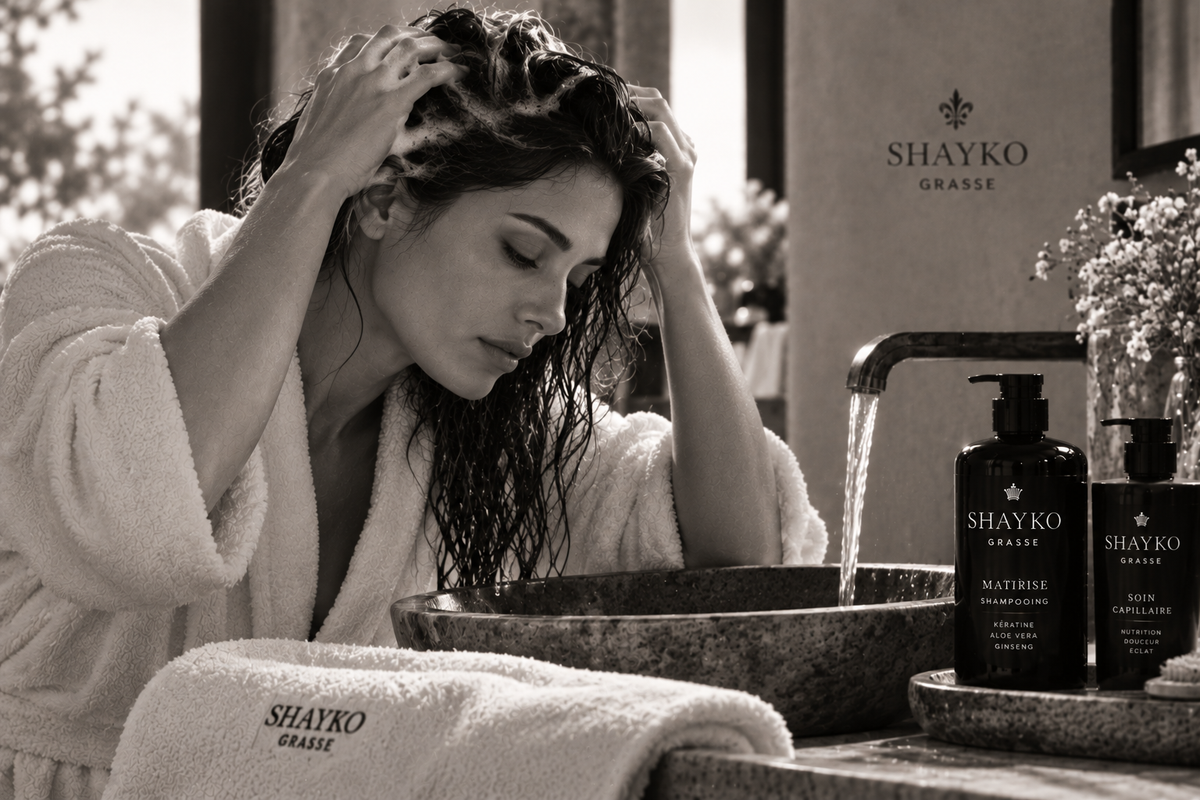
For a long time, many rules have circulated about shampooing.
You should never wash your hair every day.
Instead, it would be necessary to wash it very regularly.
Spacing out shampoos would systematically “re-educate” the scalp.
Or again, the more you wash your hair, the greasier it becomes.
The reality is more nuanced.
Because there is no ideal frequency that applies to every head of hair.
The right frequency is the one that matches the actual needs of the scalp and hair.
Why do we wash our hair?
Shampoo is not only used to cleanse the lengths.
Its primary function mainly concerns the scalp.
It naturally produces sebum.
Added to this are sweat, dust, pollution, dead skin cells and styling product residue.
As the days go by, these elements build up.
Shampoo helps remove them.
The aim, therefore, is not to wash according to an arbitrary rule.
It is important to wash when necessary.
The scalp largely determines the frequency
Two people with apparently similar hair may need very different washing routines.
A scalp producing more sebum may require more frequent shampooing.
A less oily scalp will generally allow you to space out washes further.
The level of physical activity also plays a role.
- Exercise.
- Heat.
- Sweating.
- Frequent wearing of a helmet or head covering.
- The use of styling products.
- All of these can alter the necessary frequency.
That is why simply counting the number of days between shampoos is not always relevant.
It is better to learn to observe.
Can you wash your hair every day?
Yes, it may be appropriate for some people.
Washing daily is not necessarily bad in itself.
The essential question then becomes: what do we use to wash our hair, and how do we do it?
When washing is frequent, the gentleness of the formula and the gentleness of the technique become even more important.
- There is no need to scrub vigorously.
- The scalp can be gently massaged with the fingertips.
- The lengths generally do not need to be rubbed at every wash.
- The lather that runs off during rinsing already helps clean them.
Is it absolutely necessary to space out shampoos?
Not necessarily.
Spacing out washes can be perfectly suitable for some people.
But forcing an uncomfortable scalp or one heavily loaded with sebum to wait several days simply to follow a rule does not make much sense.
Sebum has an important natural function.
It notably helps protect the skin and the hair fiber.
But when it accumulates with sweat and impurities, the scalp can become less comfortable.
The right frequency is therefore neither the shortest nor the longest.
It is the frequency that keeps the scalp clean and comfortable without unnecessarily increasing the number of washes.
Can a greasy scalp really be « re-educated »?
The idea is appealing.
By gradually spacing out shampoos, the scalp would learn to produce less sebum.
Reality is more complex.
Sebum production depends on many factors, particularly individual and hormonal ones.
Changing your habits can sometimes alter the appearance or daily management of your hair, but this does not mean that the sebaceous glands have truly been « re-educated ».
It is therefore preferable to avoid overly rigid rules.
Observing remains more useful than counting.
And what about dry hair?
This is where a fundamental distinction emerges.
The scalp and the lengths do not necessarily have the same needs.
A person can perfectly well have roots that become greasy quickly and dry lengths.
In that case, waiting until the lengths appear dirty before cleansing the scalp is not necessarily the best strategy.
- Shampoo can be focused mainly on the roots.
- Complementary treatments can then be adapted to the lengths.
- This distinction makes it possible to build a much more precise routine.
The washing technique matters as much as the frequency
- A few simple habits can enhance the ritual.
- Thoroughly wet all the hair before applying shampoo.
- Distribute a reasonable amount of product.
- Massage the scalp with your fingertips rather than your nails.
- Avoid unnecessarily rubbing the lengths.
- Rinse thoroughly.
- Then handle the hair gently when it is wet.
- The quality of the wash therefore does not depend on the amount of lather produced.
- Nor the force with which you massage.
- The precision of the gesture is often more important.
At SHAYKO, three shampoos but one philosophy
With MAÎTRISE, MATIÈRE and LUMIÈRE, we chose to start with the needs of the hair rather than impose the same ritual on everyone.
MAÎTRISE supports hair seeking greater discipline and fluidity.
MATIÈRE is intended for hair seeking body and presence.
LUMIÈRE supports the softness and radiance of the hair fibre.
But whatever formula you choose, one principle remains.
Shampooing should fit into your rhythm.
Not the other way around.
Learning to observe rather than follow a rule
Ultimately, perhaps the question is not:
“How many times should I wash my hair?”
But rather:
“When does my scalp really need to be cleansed?”
- When the roots become oily.
- When the scalp seems weighed down.
- After heavy sweating.
- When product residue has built up.
- These are the signs that should gradually guide the rhythm.
An effective hair care routine is not necessarily the one that perfectly follows a schedule.
It is the one that knows how to adapt.
At SHAYKO, we deeply believe in this idea.
Observe before acting.
Understand before multiplying steps.
And choosing the right consistency over an absolute rule.
Because when it comes to care, balance is rarely a matter of numbers.
Above all, it is a matter of listening.
“The right rhythm is not the one dictated by a rule. It is the one that respects the balance of your scalp.”
SHAYKO Grasse
Quand le soin devient une signature.